Greeting readers and a Happy New Year to you all!
I am in the works of preparing for two music projects:
1. Chorus in Edmonton Opera's the Magic Flute
2. Alto in the Canadian Chamber Choir
A reflective look at 2014 made me realize I had some amazing choral opportunities. I got the chance to tour to Toronto, Ottawa, and Halifax with Pro Coro. However, the reality of finding only fleeting satisfaction with immediate achievements is that I always wonder: what's next?
In this case, what's next is that I am the newest Alto in the Canadian Chamber Choir (CCC). I have very vivid recollection of the first time I saw them sing. They were touring through the Prairies around 3-4 years ago. I was in my first season with Pro Coro as a substitute member and I was also still singing with my women's choir, Belle Canto. The CCC performed a concert at McDougall United Church and I sat there in awe at their elegance, precision, and clarity while executing choral music. I had never heard of them before. When I learned more about the group, how they incorporate professional singers from across the country and join together at a specific location in Canada to rehearse and tour, they appeared as a elite and untouchable entity. All the singers live in different cities and individually prepare their music so that they can just fly somewhere and form a cohesive ensemble. This appeared an impossible feat since I was raised in groups where we rehearse weekly. It is challenging enough as it is to form a cohesive ensemble while living in the same city. I tucked the prospect of being able to sing with such a group away in my mind and added their name to my choral bucket list.
Confidence: it is a significant mental barrier to overcome. My best approach at overcoming the inner voice of self-criticism is through thorough preparation, increasing experience, and patience with self. I didn't realize it, but in my past three full seasons with Pro Coro, I had been building skills in all the aforementioned areas. Pro Coro, to this day, has introduced me to some of the most challenging pieces of choral music that I have ever sung. There is something to be said of fear desensitization through repeated exposure. Only through practice can you find ways of preparing music that is efficient to your learning style while working with the focused intensity required in professional groups that run on constraints of time and money. My last year touring with Pro Coro also allowed to to meet other professional singers, blog readers, and reconnect with old chorus friends. Some of these singers sang with the CCC. For the first time, I began to realize maybe that it wasn't such a ridiculous idea to submit an audition tape. I had unknowingly acquired skills over these past few years to be able to be considered for ensembles such as CCC. My taste of singing with some of the CCC members at a pop-up music reading session for their Cypress music series at Podium 2014 solidified my resolve to apply when I got back to Edmonton at the end of May.
The rest is history. Well, not quite. It was easy enough to mail off an audition package. At the end of June, I received notification of my acceptance into the pool of CCC singers. I was ecstatic! I knew before applying that just because a singer is invited to be a part of the roster, you may not necessarily be chosen for tours. There is a core group of singers and additional singers are called for projects for varying reasons: repertoire requirements, vocal color, budget etc., There are a lot of changing variables. Singer expectations have to be managed, this I understood. In the middle of September, two weeks after starting a new job with the school board, I received an invitation to tour with the CCC in February 2015. I sat in shock at a staffroom table holding my iPhone in one hand and eating my lunch with the other. Elation was soon greeted with stress. I began brainstorming how exactly I would pitch this absence to my new administration. Over a two-week period of discussions with the admin and creativity regarding hours adjustments, they approved my absence. At this point, I did a fist pump into the air in the privacy of my office after reading the e-mail.
As I wrote to conductor, Dr. Julia Davids, in June when I was notified of my CCC acceptance, "I think that the CCC does amazing work, and while I feel like blogging does connect to choral readers, the way that the CCC materializes within choral communities does something words alone cannot do: create music."
And with that, I'm setting a goal to connect to singers and blog readers while I am touring Kingston, Perth, Ottawa and Montreal with the CCC. I'm excited to connect with more lovers of choral music throughout this country through social media and choir.
You know how to reach me.
Saturday, January 10, 2015
Wednesday, December 10, 2014
The Making of The Great Human Odyssey Soundtrack - A Chorister's Perspective
| Ready to perform for a live studio audience |
It blows my mind what can happen in 28 hours.
That is the amount of time Pro Coro had to record all the vocal parts for the documentary, The Great Human Odyssey. We received a copy of the coiled music, still warm from the printers, on Monday at 6 PM and we finished recording at 10 PM on Tuesday. Furthermore, in that time, we also performed the work to a sold-out audience at the Winspear for the Sound, Light, Motion Event hosted by Make Something Edmonton.
I had an inkling that this would be a pretty cool project but it didn't fully hit me until I saw the amount of media exposure there was in anticipation of this unique event. It is not everyday that a project of this size is realized while recruiting so much participation from the local arts community. The Edmonton Symphony Orchestra recorded all the orchestral lines and the film crew decided to use an live choral voices for all the recording instead of synthesizers.
The documentary gathers film footage and interviews from individuals all over the world over the span of 18 months. The documentary content investigates the journey of humans outside of Africa. There is an insightful interview and stunning teaser trailer released online for you to learn more. The three-part series airs on CBC in 2015 on David Suzuki's The Nature of Things. The unique part of this project is its connections to Edmonton. The filmmaker, Niobe Thompson, is from Edmonton as well as the composer, Darren Fung, who had less than seven weeks to compose the score.
Monday night was stressful because we had just received the music and two hours later we were performing it in front of a live audience. However, the warmth of the audience paired with the choir's first glimpses of the footage accompanying the music melted away most of our hesitation. Our vocal parts were just one component of this mammoth machine of Art. We were just coming in for a few hours to contribute our voices for aural storytelling. I can't even begin to imagine how the crew and filmmaker, Niobe Thompson, have been dreaming and living this project for the past few years. You just sense this grateful and excited energy from all of the crew which inspired us, as singers, to help them fully realize their vision.
It was my first time using a click track played through a one-sided headphone. It was a constant metronome click synced with the tempo markings in the music. The other ear was left open to listen. What I found right away is that having one ear blocked wiped out my ability to listen to singers around me and tune chords so I wore as much of the headphone off of my ear as possible during the actual recording on Tuesday. We also popped in some recording tricks to decrease noise, such as wearing slippers or flattening our music stand and turning them 180 degrees to help remedy the scrape of our page turns on the metallic stand ledge. The ESO had also been recording Monday afternoon and Tuesday morning so by the time Pro Coro arrived on Tuesday afternoon we were able to hear the metronome clicks as well as the orchestral parts played back into our ears as we were singing. I can't even begin to imagine the amount of quick turnaround the crew had to do in the recording booth since Darren was able to just say "two bars before measure 40" and they would be able to pull up those exact bars of orchestral accompaniment in our headphone and we could begin singing. The process also demonstrated the fluidity in music recording. We would add or remove lines, try different voicing on parts, sing different melodies in the piano reduction, change vowels, add more notes into the chord - it evolved into this organic process where the music was being created and tweaked right in that very recording session. Darren was having so much fun that there was no increased stress with the last-minute edits. There was an open willingness to experiment and see what we could come up with.
It is exhausting but satisfying to emerge from a 28 hour process that included six hours of recording and a two hour live concert. The entire spirit of the Make Something Edmonton movement is to take the visions of Edmontonians, and with community self-reflection, ask how we can help so individuals can realize their dreams. As a result, we create this common goal of a vibrant city that runs on community powered momentum. I'm left wondering when's the next time I can do something as cool as this.
| Recording is a wrap! |
| I also had the chance to sing with Elizabeth, a blog reader and chorister in Pro Coro #CONNECT |
Tuesday, November 18, 2014
mèi mei
![]() |
| Photo Credit: Nanc Price Photography |
In October, I started a ukulele coverband with my sis. We had talked about forming a group for a while. We even had our band name picked out: mèi mei (translation: little sister in mandarin). However, securing a gig at the VIP Reception for a Nina Haggarty Centre of the Arts Fundraiser expedited our band's formation.
It not confidence boosting to admit that you are the weakest link; however, it was true in this case. The only instrument I really had an
ever trained was my voice. As you can imagine, there was as steep learning curve for me to be able to play basic chords on ukulele while singing at the same time. I have terrible fine motor skills. At the same time, nothing ever gets better without practice so I took the challenge to develop my brain's motor cortex regions. We carried off our first gig well enough with the ambient noise of the cocktail party to disguise any of my glaring musical errors.
The whole process gave me a glimpse into how my neural networks consolidate new information. I gave myself very basic goals. My first week's focus was just holding my ukulele so I wouldn't be crushing my contorted thumb behind the bridge. The next week was trying to play chords and sing at the same time at a reduced tempo. The next week was learning that I can strum in different patterns to create rhythm. The following week was attempting to sing right words, play correct chords, strum, and keep a steady tempo. The only strength I have is that I am able to automatically sing a harmony line because I can hear it in my head. Plus, I am strumming the chords so I am supplying myself the notes.
There were short intense periods of practice everyday. Drilling awkward chord transitions and willing my fingers to move with more accuracy between chord postures were at the top of my list. I felt a sense of satisfaction when my fingertips would tingle due to lack of sensation. I was forming callouses! One step closer into becoming a ukulele instrumentalist. I began learning on my niece's ukulele that is green and covered in tropical fruit. As the gig approached, I decided the week before I should pick up my own ukulele. While I was tempted to purchase a colored one, the sound was terrible so I opted for something in the mid-range.
Following the reception for the Nina fundraiser, we even had the chance to sing some holiday tunes for a private shopping event with Cory Christopher at Simons this past weekend.
Thanks to Nanc for these amazing pics from Simons!
While mèi mei's future is undetermined at this point in time, all I know
it's fun to spend some time with my sis and have the courage learn
something new.
Saturday, November 15, 2014
A Leap of Faith - An Interview with Canadian Choral Composer, Jason Noble
Braving the icy chill from Edmonton's abrupt onset of Winter composer, Jason Noble, shakes off the bite of the windchill as he
enters the warm surroundings of Remedy Café.
He sits down to discuss the premiere of his newest choral work, Missa
Remissionem Peccatorum. Pro Coro Canada sings the debut of the piece at their
concert on Sunday. In addition to his work as a choral composer, Noble is a
musician and PhD researcher at McGill's Music Perception and Cognition Lab.
Noble sings with voces boreales, a professional choral ensemble founded by Pro
Coro's Artistic Director, Michael Zaugg. Missa Remissionem Peccatorum is
Noble's largest choral work to date. Drawing upon his previous history with
Zaugg as a singer, Noble states that it gave him a better perspective when
writing a piece for one of Zaugg's choirs. "Zaugg has a compositional
approach to conducting. He looks at scores so analytically. There might be
sixteen independent lines going on at one time and he helps choirs see harmonic
underpinnings, understand global textural effects, and how each note functions
in terms of the overall sonority. As a composer, that is how we would
look at a score too,'" Noble says with a tone of deep appreciation.
"He's also very passionate about contemporary music," Noble
continues, "to have somebody gifted at bringing out inner intentions
and the compositional structure of a piece... it was a real gift," Noble states
as he reminisces about his time when Zaugg conducting voces boreales in
Montreal before moving to Edmonton.
This Sunday will not be the first time in which Pro
Coro has premiered one of Noble’s works. "The first piece that I wrote for
Michael was The Shadows Flee Away
which Pro Coro did over a year ago. I think everybody would agree it was a
difficult piece. It was 16 parts throughout with polytonal layering, lots of
textures, and [Pro Coro] did a great job," he states. "As much
as I was happy with that piece, it helped me grow as a composer," he says.
There are challenges associated with setting sacred
text for secular audiences and still making it relevant. Noble casts a
contemplative look downwards while he formulates his loci of thought into
words: "Liturgical composers in earlier eras could just accept the text as
something the audiences both know and believe. We live in a multicultural age
now. Where we have people from all different backgrounds of faith and no faith.
It would very naive to assume modern audiences will receive these texts as
universal truths or as affirmations of unifying faith as audiences from
previous eras might have. I think a lot of composers in the 20th and 21st
centuries cut themselves off from tradition, whether that is musical or
religious. The idea of complete renovation. Something radically new and
different. I believe that we still have a lot to learn from the wisdom that has
been handed down to us through the ages. The emphasis on the now and the new
may be the sources of problems we face in the world today. Maybe those previous
generations knew a few things that we would do well to learn from, including
the teachings of faith. I try to find values in those teachings that are
morally legitimate, even in the world today, without alienating people from any
background. For me, the concept of forgiveness is one of the most
powerful ones. I don't want us to live in a world that loses the ability to
forgive. As opposed to radical individualism, where you're only thinking
about yourself and your own needs. We all make mistakes and I want to believe
that we can still forgive others and ourselves even in a secular world.”
The concept of forgiveness is poignant in Noble’s Kyrie section. "The movement
is about the confrontation with sin. Sin is the recognition of having done
wrong in whatever moral sense that means to you. That sense of shame and
self-reproach that is familiar to most people. The Kyrie is not a prayer to some sort of deity or God, although it can
be interpreted that way if you wish, it's more of a hope that wrong can be set
right. And wrong, once done, doesn't have to define you forever or be
irreparable. Mercy is essentially a hope this can heal. Not a literal request
for somebody to set things right for you. Just a hope and faith in the universe
and in other people that forgiveness and reconciliation is still possible even
wrong has been done," Noble summarizes with a philosophical fluency.
There is a sense of balance while Noble outlines how
his personal upbringing has shaped his worldview: “I wasn’t brought up in a
church-going family. My parents wanted me to grow up and make up my own mind.
Now I sing in a Cathedral Choir, so I have more exposure to the teachings of
Christianity than I did as a child. I think I take it in the same way I take
philosophy books or other works of Art whether secular or sacred. All of them
have something to teach me. All of them have something meaningful and beautiful
that I can make meaningful in my own life. It’s not about which one is right or
wrong. It’s about finding the value and meaning in all of them that come
together in my own personal worldview. I'm hoping to convey something through
the selection of text and through the music that I write.”
Art communicates through the transmission of meaning
from one mind to another. This concept ties in with Noble’s research at McGill
where he investigates the processes of thinking and interpreting that are
common between people. Even though there are breakdowns in the message between his
compositional intent and audiences, he notes that the process is a leap of
faith. “As a composer, I know that meaning is always interpreted against a
subjective context that is constantly evolving for everybody. By definition, it
is impossible that the meaning that I have in my mind while writing is going to
be the same for any one member of the audience let alone all of them,” he says
while laughing at this lofty goal.
Noble views himself as a top down composer: “I don’t
start with motives and materials and build something up out of them. I start
with global intuition and feeling I am trying to work with. From that
intuition, I get a sense of form. And then down from there into selecting materials
that are appropriate to the concepts I am working with. Form and material and
concept are all very interwoven with one another. There are still lots of
choices to make, if I ever get it right!” he says while laughing before
continuing. “What I want the work to be is clear from the beginning. If it is
not clear, then I spend lot of time meditating on what I am trying to achieve. In
the pieces I am most proud of, the musical choices follow almost as a matter of
course once that concept is worked out.
I try to restrain myself from moving on until the concept is very clear.
To the point where it’s almost self-propelling and the process unfolds where I
feel like an observer and not an agent. That doesn't happen every single time
but it happens at the best times,” he states in describing his compositional
process.
There is an importance in how new music can document contemporary cultural identity: “We live in an age where identify is
very plural and divided. In a big way, one of the reasons why I want to be a composer
and write works like this is to draw attention to values that stand apart from
the general cultural and moral currents around me. It would be far easier to produce
music in a popular domain, using techniques, which are known to be popular. I
don't want Art to be a commodity. I don’t want it to be something that’s just there
to give people what they ask for because they ask for it. If you do that, then
you just reinforcing people in what they already know. Which means Art will
never move forward. Art will just become the perpetual recycling of things that
are already known to be pleasant, and that’s not how new meanings are
discovered. Our age deserves to have a unique voice. Our age deserves to have
an expression through Art that documents and expresses what is unique about
being alive today. How our age is not the same as ages past. What are the
challenges we face? What are the feelings that we deal with? I don’t believe
the best way to achieve that is by using the materials earlier musical ages
have generated. But, at the same time, Art loses its power altogether if it’s
written in a way that too esoteric or arcane that people can’t relate to. I don’t
want to be a strictly academic composer that is only writing for my colleagues
in the University while the rest of the world is unaware. I want to write thing that have the potential to
reach out to people but challenge them. Open their eyes to things that
might not familiar or comfortable. I hope, by my leap of faith, that they find
meaning in,” he summates, highlighting many of the themes from
the conversation.
There is an overwhelming sense of gratitude when a
Noble professes how honoured he is when a choir gives his music a voice. He
clenches his fist in front of his chest, "it lives in here for
months," he says before noting the sense of release he feels when he hears
it live for the first time. “I really admire Pro Coro. I think it’s great you
have a performing ensemble of this caliber here in Edmonton and that you do
take on these challenging projects and master them to the degree that you do,”
he says with affection. Thus, it was fitting that Noble’s opening statement to
the choir at rehearsal on Friday night was just simply: “I love you.”
Tuesday, November 11, 2014
An Interview with Michael Zaugg, Conductor of the 2016 National Youth Choir
Michael
Zaugg leads the way to his office. The hallway is filled with concert posters,
which have been plaqued and mounted on the wall. A closer look at the posters reveals the signatures of soloists. The names amongst the array of
posters include The Cantata Singers of
Ottawa, voces boreales, and Pro Coro Canada. At the end of the hallway
before turning into his office, there is a room lined with shelves, solely
dedicated to music storage. Zaugg settles into the chair behind his desk
and a quick look behind him shows a trio of glass message boards with dry erase
etches of future repertoire ideas and thematic concert brainstorming. The board
on the far right already has repertoire and commission thoughts for the
National Youth Choir 2016.
In
the past ten years since arriving in Canada, Zaugg has been Artistic Director
of the Cantata Singers of Ottawa,
The St. Lawrence Choir, voces
boreales, the Montreal Choral
Institute, Chorusmaster of the Montreal Symphony Orchestra, and is now
beginning his third season as the Principal Conductor and Artistic Director of
Pro Coro Canada. During the Podium 2014 conference in Halifax, it was announced
that Zaugg would be the next Conductor of the NYC in 2016. Conducting a mass
choir of elite youth choristers is not unfamiliar territory as Zaugg has
conducted the Ontario Youth Choir and Nova Scotia Youth Choir in previous years and also World Voices, a 40-voice choir of
World Youth Choir alumnae; however, it will be his first opportunity at
the helm of the NYC. Singing as a tenor was an integral part of Zaugg's musical
upbringing. His choral experiences included tours with the Swiss Chamber Choir,
the Chamber Choir of Europe, the Stockholm Chamber Choir, and five sessions in
the World Youth Choir. Zaugg outlines his aims for the NYC choristers, which
include, exposing them to great choral works and certain musical techniques. “I
hope these young adults work in their communities and carry on some aspects of
what they will be doing into the future,”
he states. Zaugg makes it clear that there will be no slackening in his
professional-level expectations of
these youth choristers. He wishes to instill a high-performance work ethic in
these budding young professionals. For those looking to become conductors, they
can transfer teachings to their own work and increase their tools to help
better prepare them for positions of musical leadership.
Zaugg
reminisces upon his own memories from the World Youth Choir with fondness. “I
arrived in Helsinki and then we took the ferry over to Tallinn. From that moment I stepped into a different world and it
was only the morning on my flight back to Zurich that I realized that I had to
get back into real-life. It had been a month of other-worldly experience,” he
said. Prior to WYC, Zaugg’s interest in conducting was already developing
since he was teaching highschool music in his early 20s, conducting a girls
choir and amateur choir, and was assistant conductor for a symphonic choir. “My
early career path leaned towards
pedagogy. There was always the element of making music, but being a musical
pedagogue was foremost. Later on
it was key moments, like hearing fantastic choirs, and saying: ‘That's what I
want to do! I want to learn how to create that sound and do that particular
music,’” he states. Upon
arriving in Canada, Zaugg worked primarily as a conductor and in his position
with the Cantata Singers of Ottawa,
he tried to implement sound ideals from Scandinavia. Once he founded voces boreales in Montreal, he
began to see how he could shape the free and colorful textures of voices and
demonstrate a different evolution of choral sound. His approach with Pro Coro
Canada has continued in this direction. “Pro Coro's full and vibrant
sound wasn't here when I came 2.5 years ago. Working with a youth choir is very
similar, young singers just need more guidance. The best thing is to always
model what you want. I think my
ears are tuned to hear individual voices, so my instruction is always very
direct and that transfers into the work with the choir. I think the choirs had
to get used to direct feedback," he says with a smile, breaking his stoic
expression. His approach to differentiate between different voices stems from
his Stockholm training. "I've sung so much for so many different voice teachers and conductors, I have
acquired the vocabulary to solve various problems. It solves the problem
without have to rehearse a section over and over," he says providing a
rationale for his direct approach.
| Epic Photography Inc., Ian Jackson |
In
the two weeks given to prepare the NYC, Zaugg recognizes there will be no
problem so long as the singers
are prepared. He notes that he rarely takes pieces out of a concert program.
"My programs have a theme. It is hard to cut something out because the
story falls apart," he says. Indeed, a quick glance again at his
brainstorming notes behind him reinforces how carefully he plans each
repertoire item.
Zaugg
hopes that NYC singers will recognize that Alberta is a great choral province.
Perhaps it will attract some young talent to Alberta and these singers will return home to transfer these
teaching and experiences into their own communities. Furthermore, Zaugg notes
that it is important that choristers have a great social time, forming bonds
that they will keep for a lifetime. As any chorister knows, it is the on-stage
and off-stage bonding that completes a musical experience.
Links:
Follow
@Podium2016 on Twitter
Thursday, October 23, 2014
Catching up with Phillip Addis, Figaro in Edmonton Opera's Barber of Seville
Metallic shelving units line the perimeter of the Jubilee
Auditorium rehearsal hall. They are laden with props. A quick glance around the
room reveals a barber’s chair in one corner. There is a side cart decorated
with razors, combs, and a tall glass jar ready to disinfect any used combs. The
stage manager helps me to clear a spot on the wooden prop vanity to interview
Edmonton Opera’s leading man, Phillip Addis, playing Figaro in the Barber of Seville. Addis relaxes back in his seat with a sense of calm. He is no stranger
to Principal roles having sung the title
role in Pelléas et Mélisande with
the Opéra Comique in Paris and Il Conte Almaviva in Mozart's Le Nozze
di Figaro with Pacific Opera
Victoria earlier this year; however, this is Addis’ Figaro debut.
“It’s been a good rehearsal process because
the first time through a role, you prepare as much as you can. But when you
start staging, often you start to have realizations as to why the show flows
the way it does,” Addis says with a mature sense of insight. “Once you start
listening to what your colleagues are saying in the dialogue, it just changes.
Instead of imagining what they’re singing, you become a listener engaged in a
conversation. There’s something more immediate about the relationships as opposed
to when you’re just reading it from the score, trying to picture how they’re
going to deliver their lines in between your lines,” he states highlighting the
collaborative importance of his fellow cast members.
In preparing for his debut role, Addis reveals that he did
not want to watch any videos prior to coming to the rehearsal process. He
elaborates on his rationale: “I didn’t want to end up being a copycat. I know
there’s a lot to be learned and there’s a lot of great resources out there but
I wanted to make sure I was fresh and a clean slate for the direction both
dramatically and musically. It gave me more freedom
to figure it out myself, who Figaro is for me.” By unraveling the layers of his
character, Addis found that Figaro’s primary motivation is money. The prospect of success and reward is irresistible.
Figaro is the grease that makes the town run. He maximizes
on his influence as a barber and is able to exploit the knowledge of his
diverse networks. As a result, he anticipates outcomes as problems
are approaching. Addis also sees Figaro as being very observant character that
soaks up facts and emotions behind what people are saying. However, at the
core, Addis views Figaro as a sympathetic character. “Figaro just wants people
to be happy and he wants people who love each other to be happy because that
translates into success for him and money as well,” he states.
There is an overall sense of urgency because Figaro is
constantly juggling multiple storylines. In order to convey this to the audience,
Addis must exude an energized physicality on stage. “I don’t want him to come
across is just having had too much coffee, although there is a bit of that. I
am trying to be fairly wide-eyed and physically exuberant… he knows there is no
time to lose. Overnight, this opportunity could pass him… otherwise [Rosina]
will be forced to marry Bartelo. He is keenly aware of the pressures of timing
and that excites him instead freezing him into a panic.”
Figaro’s opening aria is in no way relaxing. Addis laughs as
he reflects on this fact. “The singing is challenging and we’re doing a lot of
active things. He’s not just singing about his life, he’s reenacting it all,” he
says. However, once everything is cleared from the stage, there is one brief moment of quiet before the Count arrives
in his barbershop. From that point onwards, it’s non-stop for Figaro until the closing
curtain.
In order to generate the energy required for the role of
Figaro, Addis shares that he is still searching for that balance. “Occasionally,
we’ll run through a scene and I’m a bit out of breath by the end of it. But
that’s good. It means it’s a proper challenge. Hopefully, it means that what
I’m doing is not boring,” he states before elaborating on the importance of
breathing. “If you’re holding your breath the whole thing is off... I think
that ties in with the idea that if [Figaro] is truly anticipating the problems that
are going to arise then I need to anticipate where I need to take a deep breath
before a burst of activity. The idea of that deep breath, wherever it may lie,
it is supportive musically but it can also work dramatically too. If you want [Figaro]
to be clear-headed, then he can’t be tense and frantic,” explains Addis. He
notes that the goal of the whole ensemble has been working on exuding energy
but being in control of the situation as well.
There is an allure of the Operatic form for Addis: “The thing
about Opera is that so much that goes into the storytelling. It can be really
engaging. But there’s a certain comfort in it. I find it less exposed than
concert and oratorio work. In those other forms, it’s just you and your voice.
You’re doing all the storytelling. And it’s between you and the accompanist and
the conductor telling the story musically as well. There is no visual crutch so
you have to be so precise. It’s just more exposed… In Opera it’s quite
different. First of all you rehearse in the same setting for a few weeks. You
get to pass the responsibility of the storytelling between more people… It’s a
more complicated collective relationship.”
As Addis prepares for future projects, he finds himself
drawn back to the fundamentals of his craft. “I’m more aware not of things I
want to improve and explore technically, which I think will serve me well for
the larger roles that come along, and truly essential to get through the larger
roles in the repertoire. [The idea of being a lead character] that, in itself,
I don’t find scary. But it’s everything that goes behind making a performance
that much more engaging… I’m trying to make sure that I’m always trying to put
the best performance forward,” he states with a sense of humility.
In the days leading up to opening night, Addis is looking
forward to the sitzprobe. The singers will get to rehearse with the Orchestra
for the first time. “I’ll be grinning. I sometimes get excited to the point
where I get teary-eyed. I love it. It’s a gut reaction. There’s nothing
artificial about how profoundly orchestral music moves me” says Addis. He
summates his thoughts on Opera: “The blend of great orchestral music with great
vocal writing. That’s why I’m in this. It’s what I love the most about Opera
and other classical vocal repertoire. It’s got two things I absolutely adore
fused into one.”
All photography by Nanc Price courtesy of Edmonton Opera
Tickets are available from the Edmonton Opera Box Office (780-429-1000) and online.
Barber of Seville Shows:
Saturday, Oct. 25, 8 p.m.
Tuesday, Oct. 28, 7:30 p.m.
Thursday, Oct. 30, 7:30 p.m.
Monday, August 4, 2014
Survival of the Fittest - What Indie Opera Is Doing Right
This past weekend was the opening of #UncleJohn and it was exactly the kind of production I have hoped would come to Alberta. It was musically immersive and culturally relevant - all wrapped up in a sleek, modern, indie opera company. I will reiterate what I was hearing throughout the week: "This is the future of Opera."
Members of the Edmonton Opera Chorus took a roadtrip down to see #UncleJohn at the Cave and Basin, which was a part of the Banff Centre's Summer Arts Festival. What I didn't expect upon watching the production was how familiar I felt with this show even though I had not seen anything by this company before. One of the reasons for the familiarity is their stellar marketing on social media. Throughout the past year since working with some of the Against the Grain Theatre crew on Edmonton Opera's production of Tales of Hoffmann, I've been living vicariously through social media to keep up with their productions. Even though I was not in the audience for Figaro's Wedding, I could read updates, see pictures from the production, and even have conversations with people regarding the production. Many times, social media gets a bad reputation because it can decrease our face-to-face interactions; however, there is also a balance in recognizing that social media as a powerful networking tool. For the entity that manages to balance real world and digital interactions, they are able to master two powerful communicative realms. All those tweets and Facebook updates I have seen from preparation for their other productions have developed a cumulative artistic presence in my subconscious.
There have been numerous articles regarding about the future of Opera companies, such as a comprehensive one by Michael Vincent at Musical Toronto. There are inquiries regarding fianancial viability of traditional Opera companies and the presence of niche independent Opera companies with a fresh perspective. Whatever the the successful model is, if we take a note from Darwinian concept of survival of the fittest, it is all about adaptation. Organisms with the most advantageous traits will survive. In order for any Art to survive, whether it be Opera, Choral music etc. it must be accessible to a wide population. The sea of silver-haired patrons have the time and money now to renew their subscriptions; however, if there is no move to connect to younger audiences, the demographic of future attendees remain uncertain. If I study #UncleJohn as a model organism, here are some of the successful traits within the company:
Context
AtG Theatre chooses the venue location to fit the context of the story that they are telling whether it is the Burroughes for Figaro's Wedding, the intimate Extension Room yoga studio for Kafka/Janáček/Kurtág, or the Cave and Basin outdoor patio for the wedding reception setting for #UncleJohn. The location allows the audience to be distributed throughout the set and a part of of the story. This is effective because there is nothing lost in translation in the setting. The audience doesn't have to imagine the reception space through a painted backdrop because they are sitting in the reception space. When Anna, Zerlina, Masetto, Elvira, and Ottavio are all descending upon Leporello from all angles, the audience can feel the panic of Leporello trying to a find a way out through the snaking spaces between chairs. Conversely, audience members can feel the wrath of sound from the singers tracking Uncle John down.
Language
No surprise here, but speaking in the audiences' dominant language increases understanding. It is not only the fact that #UncleJohn was translated into a new English libretto by Joel Ivany, but the show's vernacular is also current. My generation speaks in hashtags and uses terms like super perv, hot mess, and Tinder. When I heard these terms used within #UncleJohn, it unlocked an immediate sense of cultural familiarity. They were speaking my language.
Price
Ticket prices are an important dividing factor for a potential audience members. #UncleJohn prices were $25 for student/senior and $30 for adult, which is pretty much comparable to spending VIP tickets at a major movie cinema. This is also cheap when compared to traditional Opera where ticket prices offset costs high production costs.
Singers
AtG theatre has a knack for booking singers that are emerging or already established voices of Canada. The exciting part about this for me is that these singers are amongst my generation of musical peers. My choral friends have gone on to study at Universities across this country with these budding Opera singers and it is always surprising how we are all interconnected within a few degrees of separation. I often see Instagram comments by a friend regarding a singer or a text notifying me when one of their Opera friends will be in town singing for a production. It is exciting to watch young professionals at formative stages in their careers where they are taking risks and challenging themselves in non-traditional settings. A significant amount of confidence is demanded from an Artist singing endless Mozart aria runs amongst audience members that can hear every breath and see every slight change in their facial expression. There is no hiding.
Social Media
AtG Theatre recognizes the importance of social media. They have created a network of users and active platforms to engage with the world. Artists have Twitter handles in their program biography and audience members were tweeting and posting photos before, during, and after the show. They took it even further to create Twitter profiles for Leoporello and Uncle John, which created continuity in the story. Their Facebook updates with videos and witty promo photos plus a coverage by Schmopera releasing behind-the-scenes rehearsal videos and interviews leading up to the show's release. It is not only a factor of having a social media account but it is also about being creative in its uses.
In many ways, our culture has been reinforced to admire Art through an impenetrable third wall. Thus, people can treat Art as an artifact too fragile for manipulation, something to be collected and admired with disconnect. However, reinterpretation of a work gives an art form new life because a different perspective is being shared. It is not a battle between Opera purists and Indie Opera voices, but it is about stimulating a discourse about Opera in the community. In fact, AtG Theatre's #UncleJohn is leading by example, collaborating with the Canadian Opera Company and The Banff Centre for this production. There must be adaptation to increase accessibility to audiences. It's time more people begin considering what traits we need to adopt to carry on these stunning musical scores and stories to future audiences. AtG Theatre's #UncleJohn is just just another way of how Indie Opera is doing it right.
Wednesday, July 23, 2014
Cor Flammae - Vancouver's Queer Classical Chorus
![]() |
| photo credit: belle ancell photography |
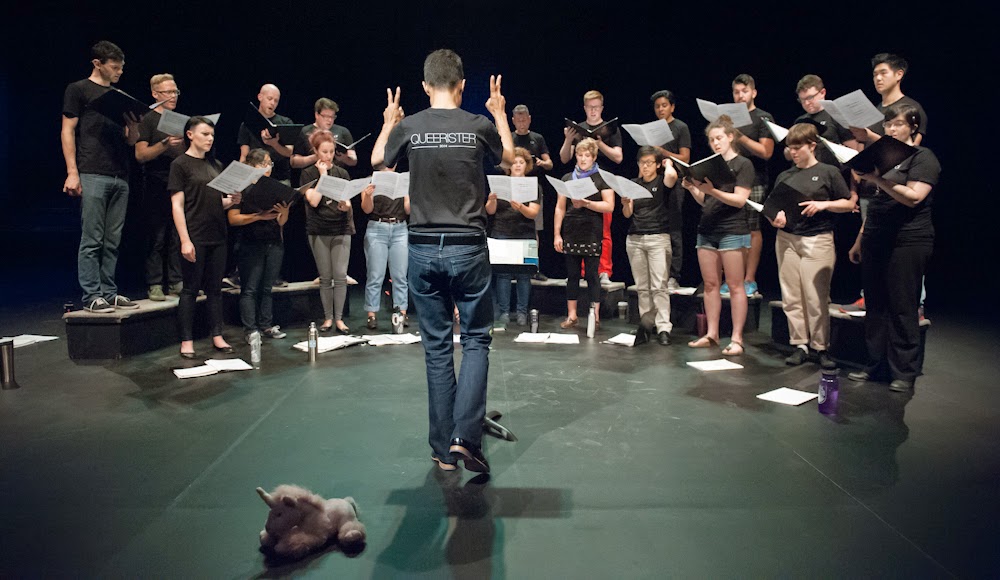
It all began with a viewing of a lesbian opera. Cor Flammae co-founders Missy Clarkson, Madeline Hannan-Leith, and Amelia Pitt-Brooke caught the premiere performance of Leslie Uyeda's When the Sun Comes Out at last year's Vancouver Queer Arts Festival. Witnessing COC Ensemble Studio Graduate, Teiya Kasahara, challenge traditional voice casting as a coloratura playing a butch character confirmed that not only was there a sphere for queer artists, but one for those performing at a professional level. At the opera after-party, Clarkson, Hannan-Leith, and Pitt-Brooke were inspired to form a professional-level queer choir, Cor Flammae, meaning "flaming heart."
![]() |
| photo credit: belle ancell photography |
Clarkson began contacting her local networks to do research into queer choral composers. Compiling a list of queer composers was somewhat challenging since Clarkson notes that historically composers are considered "straight until proven not-straight," and at the time rarely announced their sexual orientation. "We always view the past through a lens of the present. The past is an organic being," says Pitt-Brooke, acknowledging the bias that comes with historical interpretation. Much of the confirmation lies in interpreting the meaning behind omission, code words, or gender-neutral references when discussing composer relationships. One such veiled composer is Franz Schubert, who is included on the Cor Flammae programme with historical queer composers such as Samuel Barber, Gian Carlo Menotti, John Cage, Maurice Ravel, and contemporary Vancouver composers such as Michael Park and Catherine Laub. There were three defining points for the repertoire: secular, a cappella, and queer. Interesting programming choices are also present, such as in exploring harmonic similarities of works by Barber and Menotti, who were romantic partners for over 40 years. The final madrigal of The Unicorn,The Gorgon & The Manticore that Cor Flammae will sing was a composition performed at Barber's funeral in 1981.
![]() |
| photo credit: belle ancell photography |
![]() |
| photo credit: belle ancell photography |
One would think that the difficulty in forming a queer choir would be finding the choristers. Clarkson revealed that the choristers all came out of the woodwork; however, for some choristers, it didn't come without personal struggles to publicly broadcast news of their sexuality. She could think of four choristers who had to officially "come out" as a result of joining the choir. A chorister revealed their bisexuality once their mother saw them on a Cor Flammae poster. In regards to self-perceived queerness, Clarkson states the position of the choir: "The idea is to be quite liquid about it. We don't have anybody in the ensemble that overtly identifies as transgendered at the moment, but we want to break those old gender-binary habits in our language around rehearsals. We are trying to queer the very un-queer space of classical music." The established presence of queer identity in choral music is noted to be more developed for queer men more so than queer women or gender-variant people. "It even comes down to dress code, sometimes queer women and trans people just don't feel welcomed because of their presentation," states Pitt-Brooke. It is uncertain which other factors are playing a role in the decreased visibility of queer women and the gender-variant in classical music. Cor Flammae tenor, Bruce Hoffman, noted a wish to assemble a queer choir 20 years ago but was unable to locate a sufficient number of sopranos and altos to form the group.
![]() |
| photo credit: belle ancell photography |
![]() |
| photo credit: belle ancell photography |
It is significant that Vancouver has a queer population enough to form not only only a queer choir but one that performs repertoire at a professional level; this signals a cultural progression and accepted visibility of all artists regardless of their sexuality or gender identity. Every triumph in this regard creates an environment and open dialogue that supports the work all artists in a community. Kudos, Cor Flammae.
![]() |
| photo credit: belle ancell photography |
---
Cor Flammae Inaugural Performance at the Vancouver Queer Arts Festival
July 24, 2014 7:30-9:30 PM
Roundhouse Community Centre, 181 Roundhouse Mews
Tickets $30 Adults, $15 Youth/Seniors/Underemployed are now SOLD OUT.
Subscribe to:
Posts (Atom)