Showing posts with label Choral Musings. Show all posts

Friday, January 19, 2024

Fifteen Years to This Day


Dear Choir Girl readers,

My blog is 15 years old! I am as surprised as you. While I have contemplated with the idea of retiring this blog, a few readers convinced me it is not yet time. 

There is less arts journalism all the time. It is rare for a magazine or newspaper to even have funds to contract an arts and entertainment writer for local coverage these days. If you are lucky enough to get a writer in attendance at your event, you'd be lucky to have one that is knowledgeable enough to comment and critique the performance. It feels like the platforms with quality artistic discourse are ones run by the writer themselves, with some kind of Patreon subscription to make their work financially sustainable. Sure, established, popular artists will still have an opportunity to get media coverage, but what about all the emerging voices and groups that have something to say? While I do not have the stamina to keep up with my choir posts of the past, I do feel there needs to be a platform to host artistic content. Thus, this blog continues to live on. I will continue to save this online space for me to publish choral musings of myself and others as occasions arise.

It was only five years ago that I published this 10 year recap. It is heart-warming to see the array of beloved choral faces even today. It reminds me of singing opportunities I have been fortunate to experience. As well, it reminds me of how my blog has introduced me to so many artists that have significantly impacted my life. It is also sweet for me to see my very first blog post: The Beginning, where I share my hopes and wishes for this blog. 

In the past five years, I have kept on with my singing adventures, albeit, in a more intentional and focused way. I feel it is a mix of getting older, maybe wiser, and rebalancing my singing desires with diminished energy levels post-pandemic. The pandemic really overhauled how I continued to sing or not sing with all the restrictions. It is surprising to see how many masked photos I have of myself in the slideshow round-up below. 

I continue to feel an overwhelming gratitude towards this blog. Some of my closest friends began as blog readers first. If you meet me in person, you may notice that I speak more through actions than words. Reading what I am writing is the best of knowing me: my inner motivations, passions and thoughts. I sense a closeness with each reader. There is no way I can convey what I want in a quick, surface-level interaction if we were to meet in person. Thus, it means so much to me to know that you are taking your own personal time to read my content and connect with me. I have met so many fellow singers, composers, conductors, and members of my artistic community. I am moved by the flourishing and active choral scene we have here in Canada. 

While I am not sure about the future artistic endeavours coming my way, I will be sure to post some adventures here as I go. On my schedule thus far is the Canadian Chamber Choir tour in Calgary this February 2024 and Podium in Montreal this May 2024. 

Until then, please enjoy this 15 year anniversary post slideshow!

Thank-you, dear readers, for continuing to read my choral musings.

Friday, February 18, 2022

The Beginning of Happiness


Dear readers,

When a fellow live theatre goer shouted at me in the Fall 2021, "another survivor!!!" I chuckled at the statement. It took a moment before I realized that it was no exaggeration. I wish to acknowledge the hardship, adaptation, revision, planning, cancellations, equipment, protocols, and more that artists have had to navigate during this pandemic. We are, indeed, survivors. In these past two years, I have acquired black singer masks, more home recording equipment, attended zoom rehearsals when I don't feel well enough to attend in-person rehearsals, and rapid test before rehearsals. At this point in time, seeing singing faces covered with masks is the norm. I remember at one of my first rehearsals back in June 2021, I marvelled at how heads are attached to bodies, they're not just heads floating in a virtual meeting frame. How was it that 25 other bodies arrived at the same time and place to sing with me? It was such a sensory overload to hear that much sound but a welcome change to feel the energy of singers around me again.

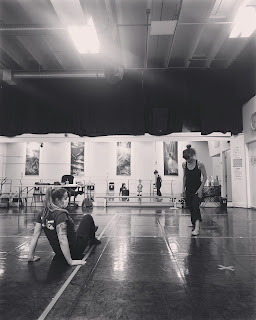
Rehearsal with Good Women in July 2021
I have never been a fan of learning the hard way. I welcome the past wisdom and advice of those who have walked the path before me. However, these past 2 years felt different as we were all figuring out how to continue with Arts creation with fluctuating pandemic restrictions and risk levels. My collaborative project with FEMME Vocal Quartet and Good Women Dance Collective was no different as we cancelled our live show, "The Beginning of Happiness," weeks before the premiere. It was a project we had all been rehearing since July 2019 and planning even before that time. Amongst the artistic core in the Spring 2021, we decided that a film would be a realistic and safe way of seeing through the project. Director of Photography, Tamarra Lessard, assembled a crew for us to film in August 2021. There were many logistics to consider in adapting the live music + dance show to a film. Park permits needed to be obtained for evening filming, costumes had to be adapted to be used in water, and most significant, the score was shortened from one hour to 30 minutes. The film is now available for streaming from February 17-24, 2022. Half of the proceeds will be donated to WIN House.

The Beginning Happiness Performers and Crew for August 2021 filming

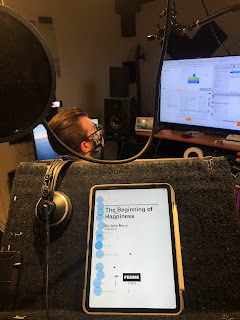
Recording at Silver Studios in May 2021 
During our recording sessions in May-July 2021, FEMME recorded the entire one hour work at Silver Studios. All the singers recorded their parts separately to stay covid safe and the recording engineers, Caleb Nelson and Amelia Chan, later layered the tracks to form the ensemble sound. This was possible since we sang to click tracks programmed to specific tempos and heard the playback of the other voices who had recorded their parts already.

My ears are greeted with the reunited sound of FEMME once again as listen to the album writing this post. The music is such sensitive and informed writing for treble voices. For a work that explores and reflects upon issues of domestic violence, there is a healing beauty within the musical storytelling. There is such a wide range of vocal textures created ranging from the warm feel of love to breathless unrest. After having this work living in my tablet for three years, I am so grateful that this music gets to live in the world. There is a wonderful sense of closure to be able to release this music and invite listeners in.


FEMME Vocal Quartet during Aug 2021 filming


The album is available for streaming and download from Bandcamp. We suggest a price of $10 for download but will gratefully accept donations above that amount. Proceeds from the album will go towards FEMME's continued work to amplify a contemporary female perspective within choral music through new commissions and performance.


Tuesday, May 19, 2015

Take 50 - Canadian Chamber Choir CD Recording


There are many times in my life when I am reminded of how lucky I am to pursue multiple passions. My daily Edmonton life is filled with speech pathology clients, playing with my nieces and nephews, working on my computer while my mom crochets and streams Asian tv shows on her iPad, watching my dad work in the garden as I hand-grind beans for an americano, late-night chai lattes with friends, biking across the high-level bridge, and live theatre in cozy theatres; however, whenever I get the chance to uproot from my local community and venture off to to pursue another passion, choral singing, it leaves me wondering who exactly I am sometimes where I have the luxury to play these multiple roles. I excise myself and transplant myself into another choral community for a few days sharing music-making with others. In this past Canadian Chamber Choir trip, the focus was on recording a C.D. entitled, A Canadian Mass: Sacred Reflections of Canada. It is an array of sacred and reflective texts by Canadian composers.

We arrived in Elmira, Ontario on Thursday evening for rehearsals and starting Friday started a three day process to begin recording 18 tracks for the C.D. As frustrating and fatiguing as it was to have to re-do takes when there were noisy infringements on the recordings atmosphere from busses hissing at their stop to motorcycle mufflers rattling on the road in the front of the church, there was a sense of silent camaraderie ride amongst all the singers and splendid moments of music making.


Tension. I was reminded of how tense I was holding myself during the recording. It stemmed from hearing the increasing number of takes announced on the speaker from CD producer, Jeff Reilly, in the recording room: "Ave Maria by Fogarty Take 34". The starting pitches were given by the Dr. Julia Davids on the digital keyboard. She stepped over the serpentine knotted black piles of recording chords, before resuming her position at the music stand to cue the choir in on a piano entry with a soft onset for the initial vowel in "ave."  So much tension. I had to remind myself to breathe, sing with confidence, and trust in my fellow singers. A recording session is like a simulated pressure cooker in how everybody responds to stress. Sometimes it is removing visual distractions, other times it is accepting things beyond ones control like a tummy gurgle or an elbow pop. Often my tendency is to leave something hard then come back later; however, that was not really an option this weekend. We had a limited amount of time to record a lot of music but I could also sense the anxiety rise exponentially take after take of an imperfect phrase delivery. There were also other moments where I could relax and bask in the searing pure tuning of some final chords like the final word "free" in Barrie Cabena's "Be a still and know that I am God" or the warm, hushed tones of Don MacDonald's "tabula rasa."
There was a nice rhythm to the recording days. It was refreshing to be able to wake up and not have to pack and commute to another town. Instead , I had the luxury of leaving all my things in one place and just preparing what I would need for the recording. Upon early arrival at the church, I also had time to explore Kitchener downtown and locate some local coffee establishments to get me through the rest of the afternoon and evening.


The recording process would usually start with a cold run-through. From there we would get basic notes from Julia and Jeff and then we do another run-through again. From there we might get more detailed notes and do another run-through, this time, starting and stopping the take. Depending on results, we might have to work backwards or just do sections of the piece. If we still needed more precision then we would do a surgical strike and record just a few bars of what we needed. After all of the inner detail work, we would usually run the piece another 1-2 times to see if we could capture any additional magic after all that work. Each piece took about 45 minutes to record on average. In between takes, I would wiping my brow, sticky from the humidity, or sprawling across the stairs on the floor of the church to see if the sharp angle could help dislodge the tension knot in my right shoulder blade from holding my music folder.

After 18 tracks and three recording days we finished our final take of that day, take 50 with Stephanie Martin's "O Sacrum Convivium." A rousing round of cheers, group hugs, and pats on the back resulted after Jeff announced completion after the final take. There was a unison feeling of relief and satisfaction.
You can pre-order the CD at the website which will be released sometime in the Fall.


There are numerous people to thank in order to execute this recording: Conductor, Dr. Julia Davids, Producer Jeff Reilly, Recording technician Rod Sneddon, the 20 CCC singers flying or driving to Ontario, the community billets hosting the singers, all the CCC CD donors, and CCC General Manager Corey Ticknor. I do want to take this time to give a special thanks to Jeff Enns. In addition to being the CCC Composer in Residence as well as CCC singer, he had to juggle so many things at the ground level to make this recording happen. He drove me to the Hamilton airport (I was the only chorister leaving from this location), connected with host families for choristers, tended to a sick pre-teen, managed church bookings for the recording, organized Sunday service, drove choristers everywhere, coordinated vehicles for rides, grocery shopped late on Friday night for sandwich lunch components the next day, and cooked extra soups and casseroles this past week to make sure there was enough food. I'm sure there were even more duties he completed with stealth that I don't even know about. It was a pleasure and a highlight to sing at his church, St. James Lutheran, in Elmira on Sunday and give back in a small way after the additional stressors he took on while maintaining his comedic charm. Covert heroes are the best.


For more social media posts from the weekend:


Monday, April 8, 2013

What is Good?


What is good? 

What does that even mean? The more that I perform and write... the less certain I am towards that term's definition. It is because it is subjective. I have played both roles: reviewer and performer. When I am critiquing Art, I attempt to provide evidence to support my viewpoints with the understanding that my definition of "good" does not necessarily correspond to anybody else's definition.

I will always have my own perspective as a performer in a concert; this cannot be accessed by a reviewer. Thus, I am always curious as to what message a reviewer will glean from a performance. Take, for example, two reviews from Pro Coro's most recent Good Friday concert (Edmonton Journal; Bill Rankin - Edmonton Arts). There were points that I agreed with and disagreed with in both reviews.

Those reviews made me reflect, in general, on the relationship between critic and performer. As much as we wish to have one without the other, that will never happen. It is not productive to channel anger towards a critical entity that will always exist. It is easy to become a victim of a bad review when negative consequences such as unwanted publicity, decreased ticket sales, and a drop in Artist morale result. Thus, it is important for readers to be smart consumers and realize that a review only reflects one opinion. Reviews should not be treated like some kind of filter of taste in order to avoid experiencing Art and forming opinions of our own. Reviews should create artistic discourse. We may choose to stage, script, or sing differently in order to evoke an intended meaning but, ultimately, we have no control over the meaning audience members will generate.

Isn't that the entire point of Art? 

Frankly, I'm interested to hear what people say whether it is positive or negative, as long as there is justification for their constructed viewpoint. It also doesn't hurt if the review comes from an informed perspective so I can at least respect their views. Any discourse is valuable whether it is positive or negative because it signals, to me, that there was enough content to evoke a response. Constructive criticism propels Art forward. If we didn't have the voice of our inner critic to self-reflect, what would motivate us? As long as there is respect for performers, there should be a freedom to express honest opinions. It is a reviewers job to critique whether or not a production was effective - whether people want to hear it or not.

I would be lying if I didn't say that, as a performer, I always want to read a good review. It is positive reinforcement and validates the hard work done by my artistic community. My next question I asked myself was:  

Why do I need somebody's opinion to justify the work that we have done? 

I don't need anybody telling me. 

We should not be afraid of criticism, nor should we protect ourselves, or those we care, from hearing it. We all must experience negative emotions as a part of our human existence. It is an impossible goal to protect people from pain. Performers have the power to choose what criticism to take and what to toss. There will always be differing opinions. Thank goodness, because I wouldn't want perform anymore if Art didn't challenge audiences to form an opinion.

Thursday, February 21, 2013

A Yeggies Thanks


Dear readers,

If you didn't already know, this blog is nominated in the category of Arts & Culture for the first annual Yeggies Awards. From the bottom of my Choir Girl heart, thank-you to those who nominated this blog!

My goal is not to write for profit, benefits, or recognition. I write because I want to. When I initially contemplated a public blog, I knew I needed a topic that would provide continuous content. I could think of nothing better than my own passion for choral music and performance. As long as I keep singing, I will have things to write. My blog has inspired me to audition more, make recordings, challenge me to think of voice science and habilitation critically, interview people I admire, and connect with lovers of music. As well, it makes me accountable for the goals that I set for myself as a musician because I document my projects and process to you, my readers.

There is such a diverse array of social media forms in the Arts & Culture category that it is humbling to be considered next to them. We all do something unique for the Arts & Culture scene here in Edmonton: a diverse Arts & Culture reviews site, a podcast discussing photography, two are podcasts focused on discussing films, one for Canadian music, and mine, for choral music and performance.

I recognize the fact that choir blogging is a niche blogging genre. I am only discussing one subset of a larger musical unit. However, my blog content is true to me, my passions, and my voice of opinion in this domain. There is such an amazing choral community here in Edmonton. If my blog has some role to play in highlighting that fact for local, as well as international audiences, my work is done.

What I am most excited about is the discussion these awards are going to generate in the city. Everybody is going to have an opinion. Everybody is going to be curious about the nominees. It is exactly the type of discourse social media should generate, especially within the area of Arts & Culture. It makes me smile to know that choral music is represented on that very list. I consider this nomination a win already.


So thank-you again to you all. I will be excited to watch my Twitter Newsfeed for the @yeggies awards winners on May 4, 2013. Unfortunately, I will be in Camrose performing with Pro Coro, but then again, I think that is a very fitting reason for me to not be at the awards ceremony.

Until next time readers, take care!

Sunday, December 30, 2012

A Choral Reflection


There is something to be said for reconnecting with people that put you at complete ease. Yesterday, for the first time in five years, my closest choral companions from my teenage a cappella ensemble, Con Fuoco, reunited for an evening. As we each took turns to provide verbal updates in a round table manner, I just kept thinking how inspiring it was to listen to the paths that some of my friends have chosen. They are diverse and unique but the commonality was that they were completely true to that person's character. Their overall life trajectory appears organic to me as a third-party observer.

It also made me think of what our teenage selves would have thought if they were able to evaluate ten year older versions of themselves. One fellow choir girl remarked how she remembers drafting Plan's A-C and how some of them included aspirations for choral conducting training. She gave a laugh of amusement at how utterly inappropriate that would be for her now. It is amazing to see what predictions form when you're forecasting the future in the formative stages of adulthood. I, too, would be shocked at how I have turned out so far. I had one main career aspiration as an overachieving teen: Medical School.

The desire wasn't motivated by any cultural pressure. My parents watched on in silence as I self-motivated myself through a full courseload of an academically-oriented program. They chose to stay out of my path of academic frenzy when I made conscious choices to forgo Halloween festivities in order to finish a Styrofoam model of a eukaryotic cell or when I started video taping for an English class project when there was a school hiatus from a teacher's strike. In University, I realized that it wasn't so much the actual dream of "Medical School" that had enticed me, but the prospect of helping people. It was difficult to realize that there are multiple options to reach this goal with my limited teenage worldview. In the early years of my undergrad, I had these thoughts when I was still convincing myself of my Medical School aspirations.

"I'm in a perpetual state of stress. I'm not enjoying my courses. I'm not doing that well in them. This sucks."

During this time, I wasn't singing regularly. I was still in Belle Canto, but after a few weeks of missed rehearsal, I was starting to feel the emotional imbalance as I had no outlet for all of these negative feelings.

As I reflected on this last night, I realized that even if I was in Medical School at this very moment in time, I know, for a fact, that I would not be singing as much as I do now. While I understand that sacrifices must be made in order to pursue career aspirations.... I do not wish to compromise doing the things I love. I am also allowed to love doing more than one thing. That includes singing in choir. It is a component of my life that more than just a frivolous leisure activity. At this point in time, my Speech Pathology and choral interests have equal priority.

I've done a mental review of my blogging year; it's staggering to see the creative explosion of content I've generated through the blog this year. I had more opportunities to sing in new ensembles in the city which included my concert with the Scona Singers and the Ordo Collective. The latter providing me the opportunity to tour to Victoria and Vancouver to perform the work. I survived the Pro Coro audition process under the direction of Pro Coro's newly appointed artistic director, Michael Zaugg. I also began writing for Sound + Noise after editor-in-chief, Michael MacDonald, contacted me via Twitter to attend a meeting. There is something to be said for meeting a mentor at the right point in time. MacDonald was the one who encouraged me to do interviews and social media coverage of the Podium 2012 choral conference in Ottawa since I was going there anyway with Belle Canto. This shaped my social media experience at the conference and gave me the confidence to dream big with my blog. As a result, I have a series of Podium posts and interviews with conductors, Heather Johnson, Ivars Taurins, Hilary Apfelstadt, Lydia Adams, and Michael Zaugg to add to my archives. My Podium 2012 coverage also led to my first paper print article in the Fall version of Choral Canada's "Anacrusis" Journal. As well, my blog garnered some local media attention for the first time in an Edmonton Sun article. My studies at the Summer Vocology Institute in Salt Lake City inspired some voice science posts as well.

To say that 2012 has been a great speechie, singing, and blogging year is an understatement. In some ways, I wonder if I have peaked given the burst of opportunity that I have been presented with this past year. No matter what, I am certain if my teenage self had to reevaluate my current path, she would initially be surprised but proud that I have not compromised either my career aspirations or musical passion. I have developed a multi-faceted area of interests such as voice science, rehabilitation, choral singing, and blogging and, by doing the things I enjoy, I have somehow formed a life template that incorporates all of my interests.

Thank-you to all of my readers this past year. I hope to bring you more inspired content in 2013.

Con Fuoco Reunited


My favorite blog posts of 2012:

What do Choristers Do?

My inaugural post for Sound + Noise and my chance to introduce myself to new audiences in a refreshing format.

The Culture of Fear

A post that challenged me to evaluate what I find fulfilling in past choral relationships and my personal feelings on how this has shaped me into the performer I am today.

A Vocal Diagnosis

A post incorporating my approach to voice rehabilitation and how this extends to vocal pedagogy.

Painting the Nightingale

This post resulted after I came home from Pro Coro rehearsal and could not sleep because I was too buzzed. The rehearsal process for Praulin's "The Nightingale" was utterly consuming and rewarding. I have been waiting a long time to sing music like this. As well, receiving a personal message from Praulins himself in response to my post was a choir girl highlight.

Thursday, November 22, 2012

A Vocal Diagnosis

We live in a world that loves labels. We love organizing, compartmentalizing, sorting, or really, anything that gives us some semblance of structure in an unpredictable world. The musical world is not exempt from this. The issue of voice labeling is something we discussed in my studies in Salt Lake City this summer. I have even heard the term "vocal diagnosis" used, as if voice typing is some kind of diagnosis by exclusion.

"Since your breaks lie here, here, and here, and you're more comfortable in this part of the range, that makes you a ___________."


My next question is: Does it matter?

Why does it really matter if someone needs to be labelled as a soprano? mezzo? tenor? baritone? bass? a dramatic soprano? or a lyric tenor with a warm lower range? Perhaps it gives us a sense of identity. Maybe a label automatically filters out the types of roles and repertoire that are inappropriate for our vocal abilities. More likely, it is a singers response to the musical construct society has created since certain roles and voice parts need to be filled. Singers need to label themselves in order to occupy these positions. I understand that. In some cases, it's how the business works, a kind of demand-and-supply type of approach. A composer writes music for a mixed SATB choir, well, there needs to be SATB voice parts to sing that piece.

However, I feel like the issue of voice labeling can create a sense of identity displacement in a vulnerable population of voice users. Of course, many careers are built from the fact that a singer's vocal abilities casts them into different character roles, such as a "Carmen" or "Turandot". But what about singers who are in the grey? Whose voices seem to straddle many different genres? Where they're in the opera chorus one day, singing medieval chant the next, and then experimenting with ingressive phonation in a contemporary piece. What should we call these vocal chameleons?

I remember struggling, in the days of my preteen voice training, to combat an excessive breathiness that only maturation would help remedy. I dreamt of the prospect of finally finding out if I would be a soprano or mezzo once my voice finally matured, as if the label would signal my coming-of-age moment as a singer. Well, I'm at the stage at which my voice is no longer in its preteen state and I'm still not so sure. But I also realized that, frankly, I don't care.  For me, this is a healthier mental approach to working with an instrument that is always changing. In general, I think voice training benefits from an adaptive and not a prescriptive approach. I prefer not to view it not as a vocal diagnosis but a constant process of vocal experimentation and discovery. My main concern is that I have command of an instrument that can perform a variety of repertoire. Also, that I'm monitoring my vocal health and making sure nothing pathological is developing while singing. The thing about choral singing is that, regardless of your voice part, compositions demand a wide vocal range as well as diversity of vocal colors. Choristers are not type cast into iconic roles. We must be able to play a wide range of parts as per the wishes of the composer and the conductor's interpretation of that vision. No two instruments are built the same, thus, it is incorrect for them to be treated as such.

This doesn't mean I won't circle a voice part when I see "S A T B" listed on a choral application. I understand I need to fit within the musical construct. If we must have a label to belong in this musical world then we must label ourselves. However, I don't feel like this proclamation needs to dictate the mental performance range of a singer. We should not be so consumed with what we call ourselves as singers, but rather, what we can do as vocal artists to effectively communicate music. After all, labels aside, isn't that what we are all here to do?

Monday, October 8, 2012

The Culture of Fear in Rehearsal


There has long been an established culture of fostering fear within a musical setting. It's controversial because it reflects what kind of teaching philosophy that you subscribe to. Some educators may choose to create a supportive and loving environment to better foster musical interaction, while some others may choose to embrace a more challenging teaching stance. There is no wrong or right way. It all distills down to teaching style and preference. While I believe that both of these tactics have a role within a rehearsal, personally, I respond to the latter method.

While I was in Vancouver a few weekends ago performing with the Ordo Collective, I had the opportunity to reconnect with an old choir friend of mine. We were joined by another performer and audience member. My choir friend and I readily agreed that we thrived on fear during rehearsals in our childhood choral experiences. At that time, what we labelled as fear, in fact, was our immediate feeling in response to conductor challenge. Spontaneous solos were not out of the ordinary if our conductor wanted to check our text memorization or searing glares cast our way if we missed an entry. Of course, we had fair warning if there would be a memorization check and we could sense fragile patience if we have already rehearsed a section multiple times to clean up entries. I understand how hearing this from an outsiders point of view makes it seem like we were were in some kind of abusive relationship. I don't deny the fact that there are some elements of perceived abuse in the previously mentioned conductor-chorister interactions. We were willingly subjecting ourselves to cold treatment in order to feel even a shred of positive reinforcement from a demanding leader. I was not surprised when I heard an aghast response from another person at the table: "There are other ways to achieve that same effect." Perhaps. I respect the fact that everybody has an individualistic response to challenge. One conductor's style of terror may not be the right approach for every chorister. However, if you were to ask me about my most fulfilling musical experiences, they did not result from being coddled by a conductor. I don't think I am alone in this regard.

It all comes down to one thing: respect. You can challenge your singers and demand the best as long as there is a level of respect. Oftentimes, when people are asked why they love a particular person, they say: "They make me a better person."

Why is that?

Is it because they are providing such boundless amounts of love that this surplus is what allows them to be improved versions of themselves? I don't believe this is the case. It all comes down to the aspect of challenge and the intent from which it has been elicited. There needs to be balance. Conductors who experiment with this equation need to constantly evaluate how many variables to manipulate. People need to be challenged by external figures. It is healthy for this to occur. I feel this applies to every relationship people consent to whether it be in a life partner or a choral one. Even with a strongly established voice of internal motivation, it is always powerful to have outside forces that demand the best. Challenge, pressure, stimulus - these are all conditions for change. If we are not challenging ourselves and taking musical risks, then what are we doing?

Love it or hate it, fear, is a powerful tool within a rehearsal. While I do not wish to be petrified at every rehearsal I attend, I know that it is sometimes necessary and that my short-term distress is a precursor to long-term learning. So for those conductors hesitant to employ a firm hand, speaking from my own chorister experience, I simply say: Go ahead and scare us. We need it.

Saturday, April 21, 2012

The Cool Kids on the Block


Greetings readers!

Last weekend, Pro Coro had a concert out in Morinville with Jim Reader as well as choirs from the surrounding area (i.e. Sturgeon Composite Highschool, Notre Dame Elementary School, and Camilla School), but I had a unique experience as a chorister... I think I was cool. 

I know, right? It was strange for me too.

I wasn't able to make it out to the schools in the preceding rehearsals so the first time that I met the young singers was on the day of the performance. My feeling from the weekend was that choristers from Pro Coro were the cool kids on the block. I'm not exempt from this cool effect because I have my own cool idol: Rajaton. When they came to my choir in highschool and stood near to me during rehearsal, I had a massive choir-girl-fan-overload moment. During the rehearsal, Pro Coro members distributed themselves evenly throughout the mass of choristers. It was interesting for me to insert myself into the choral unit because I was able to observe the reaction of others towards myself, a chorister with an assumed level of prestige. There were some who offered warm smiles... and others who were somewhat paralyzed, averting eye gaze in the hopes avoiding any potential embarrassment. If I was a teenager, I would be in the latter group.

Thus, I knew it was my duty as an older chorister to be friendly and chat with those around me since it's proper of me to initiate those social formalities. This whole situation was very new to me. But even as I was chatting to those around me, making comments about the music, complimenting a girl on her sparkly sneakers - the most I would get is a shy smile or one word answer before their eye-gaze reverted to their toes. While I do recognize that this post makes me sound full of myself, that is not my intent, since I am genuinely perplexed that my presence could induce this behaviour in choristers around me. It stems from the fact that I, personally, don't feel cool.  

My aim is just to do things I'm passionate about... as a result, how it manages to me me appear potentially cool in the eyes of others is beyond my comprehension. Admiration is all relative in terms of where you place yourself in the hierarchy of coolness. It doesn't help that, as I attempt to define these parameters, it is a completely subjective hierarchy. There will always be somebody who you admire. Thus, there will always be an ample supply of cool people for everybody to idolize. It may be Bach, Eric Whitacre, or Pro Coro choristers - Whoever it is, it's flattering to know that we're all cool to somebody.

Until next time readers, take care!

Friday, March 9, 2012

What Do Choristers Do?

Greetings readers!

You may be interested to know that I am now a guest blogger on the Sound and Noise Music Blog. Pretty cool, am I right? I will be cross-posting any entries I write for their site on this blog as well. I will also continue composing my own exclusive entries for this blog. I encourage you to visit their site and see what articles they have to offer from their passionate and diverse team of writers. Now, may I present, my premiere post for Sound and Noise:


Lately, the internet has been filled with variants of these enlightening photo memes which attempt to educate the naïve public on the perspectives surrounding different roles in our society. Drawing from my own personal experiences, I’ve decided to construct my own. I will discuss the following six views and the multifaceted role of the chorister.

1. What my friends think I do

I am sorry to disappoint… but I do not spend my rehearsals flirting with cute choir boys. As a choir girl who takes herself way too seriously and is terrible at emotional multi-tasking, my attention is focused on the musical task at hand. I am often oblivious to the fact that people join choir expand their pool of suitable mates. Don’t we all just want to make music together?

2. What my mom thinks I do

She’s not entirely wrong on this one.

3. What society thinks I do

First question I get when I tell people I sing in a choir is “Do you sing in a church choir?” To which I provide my default response of “No, not a church choir.” It makes sense; chorister roles began in the church to deliver the religious message of God. Thus, it is not surprising that the prototype chorister image still engrained into society is that of the church chorister. However, there is such a wide array of choristers in the world: professional, community, chamber, show… it’s important to recognize the diverse role of the chorister and how it suits the musical construct of each group.

4. What my dates think I do

Once on a date, I attempted to describe what I meant when I said I sang in a choir. When I started with outlining the basic choral components such as, “There’s a group of people and we sing music together”--- those semantic cues led him to respond with “Oh, like Glee!” Since I did not want to crush his enthusiastic self-generated response, I responded with “Kind of like Glee, but without the dancing… or the show tunes.”

5. What I think I do

Confession time: I love black gospel choirs. They are my choral rock stars. I wish I was black. I wish I could belt solos. And I wish I could uninhibitedly emerge from the choir with my arms above my head, gesticulate to an invisible overhead entity, and praise the lord in a Q&A format with the rest of the choir.

6. What I actually do

Black gospel choir dreams aside, what I actually do as a chorister in my choir is sing early, classical, romantic, folk, and contemporary repertoire, tour to national and international music festivals, record diverse repertoire, and rehearse weekly with a dedicated group of singers. No matter what construct choristers find themselves in, we are all united with a common passion and a collective voice. As a result, I think that what we do, as choristers, is pretty awesome.   

Until next time readers, take care!

Saturday, February 25, 2012

The Face of an Angel

Greetings readers!

I should really start this post off with a disclaimer because, for those who don't know me in person, I have this tendency to state my blunt observations with a dead-pan delivery. For some reason, I think people find it humorous, as a result, I've slowly embraced it as my comedic style. If you aren't used to my tone, you might think I'm being condescending. However, I'm merely just stating a neutral comment. I do not mean for it to be taken as fact. I do not mean to generate or perpetuate stereotypes. I simply feel like stating it because it's something I've observed. In this case, my sample size (n=4) does not generalize to the population at large, but rather, it serves as a mere scientific observation from my limited experience. They're observations I would freely share with my friends; I feel that if you're reading my blog, you're a friend to me.

Due to my inquisitive scientific nature, I've always enjoyed visualizing trends. I did this in my biology courses in University when I began to notice that all of my ecology teaching assistants looked like the animals that they studied. One of my biology TA's studied bugs... he had this angular exoskeleton facial structure. Another TA studied polar bears, she had pale white blond hair with light blue eyes. Another one of my friends had a ecology TA that studied river otters. He was a scruffy looking brunette. I could not deny this observational trend.

I have begun to notice a similar trend in conductors. Have you ever noticed conductors that look like... cherubs?

Putti

Is it just me or has anyone else come across a cherub-conductor in their musical experiences? You may simply state that there are many baby-faced people in the adult-world. Yet, I believe there is a higher concentration of them in the musical realm. Do I have any scientific proof to support my observations? Absolutely not! It's just a series of observations that have led me to form a subjective hypothesis. Personally, I think that cherub-conductors have a wonderfully loving and warm look to them. Who wouldn't want to look into the face of an angel during rehearsals?

Until next time readers, take care, and take the time to notice the cherubs that walk amongst us :)

Friday, January 6, 2012

Choral Speech Pathology


An acoustic sample of "Silent Night"

Greetings readers,

I primarily discuss my choral experiences here on this blog, however, I rarely speak about the other dominant area of my life: Speech-Language Pathology (S-LP). In my program, you have the option to choose either a group project or an individual thesis and you need to decide, within the first month, which route you're going to take. Therefore, it's quite a significant program-altering choice. The department held a "research fair" where all of our faculty presented the projects which they were offering that year: studies involving fMRI neuroimaging to look at language processing in the brain, studies investigating the potential of noise-induced hearing loss from high iPod listening levels while exercising, looking at developmental language and vocabulary inventory of children with cerebral palsy... although they were all interesting in their own way... none of them really appealed to me. I knew that I would either choose a project that seemed straight-forward just to get it finished or develop my own thesis project. Since I have never been one to choose the path of least resistance, I chose the latter option. I rationalized that if I am going to spend two years on something--- I better enjoy it.

A year before entering the program, I remembered hearing about an S-LP, Merrill Tanner, from a fellow chorister's parent during a reception. Tanner was known to utilize singing techniques in her S-LP therapy practice. While I was contemplating project options, I googled her name and discovered that she was working on her PhD with the voice disorders professor in our department. I immediately arranged to meet with this professor. I didn't know what to expect when I walked into my soon-to-be-supervisor's office. At that point, I had already visited at least six other professors discussing their thesis projects but I didn't feel moved to accept any of them. This voice professor was interested to hear about my journey which led me to Tanner's research and said that I could formulate a project that that united my two interests. As well, she  knew of a set of unanalyzed data from a study in 2004 where persons with Parkinson's Disease had singing lessons with a music professor. A variety of measures were taken but the data was never analyzed. Five years later, there I was, an eager new graduate student who was willing to take on the analysis job. I spent a good two years designing a standardized analysis method and then analyzing the data.

Within Parkinson Disease, the main voice symptoms that occur are decreased loudness levels, weak and imprecise articulation, and a fast or "blurred" speech rate. Therefore, it can be hard to understand the speech of people with Parkinson's Disease. The implication of this is that a decreased ability to communicate effectively with others can lead to a gradual disengagement with others and with life in general. The muscular system in persons with Parkinson's is extremely rigid, which means that the respiratory, voice, and even facial muscles are stiff and aren't used to their full capacity or range. There's support for therapy practices which engage these muscular systems. Currently, the gold standard of Parkinson's voice therapy is called the "Lee Silverman Voice Treatment" (LSVT), which involves sitting in a room two times a day and holding the word "ah" at a comfortable pitch and volume for as long as a client can and doing this drill 15 times in a row, as well as other voice drills for an hour. While LSVT has great outcomes after 4 weeks, it's arguably not the most holistic or enjoyable way to spend a treatment session. That's why there has been an interest in relating Parkinson's voice therapy back to music since it still trains the same muscular systems as LSVT, however, the tasks are within an enjoyable musical context. Tanner's PhD work has already been noting the positive changes seen in patients participating in singing therapies and the results from my thesis show the same positive trend as well (which I'm excited to be presenting in a poster at the CASLPA conference in May 2012!). There's an argument for the fact that singing/choral voice treatment is a much more accessible (you can almost always find a choir in any rural or urban setting but you can't always find a LSVT certified S-LP) and a lower-cost therapy option for persons with Parkinson's.

I hope my previous paragraphs provided some context for the other things that are on my mind when I'm not singing in choirs. Below is a video of Tanner's research and an interview with some of her current Parkinson participants.


Until next time, take care readers!


Friday, December 30, 2011

A Choir Girl Year In Review

Greetings readers,

It is nearing the end of the 2011 year! Thus, it's time for some cyber self-reflection. It's nice having a blog because it serves as a comprehensive timeline of my choral activities throughout the year.

Pro Coro

I began this year as a substitute member and managed to become a core member by the end of the year. I must say, it's not a bad musical progression! It's amazing what happens when timing and determination aligns :) Some particularly memorable Pro Coro concerts for me were the Space concert, the Easter performance of Bach's St. John's Passion, and the three concerts with the Pro Coro artistic director candidates: Solomon, Bailey, and Zaugg. Strangely enough, I wrote two posts on the aspect of full-voice singing in Pro Coro. Once when Gervais was conducting the choir in March and again with Zaugg in November. Hopefully this is an area that Pro Coro continues to explore in the new year.  I'm also looking forward to the announcement of the new artistic director. It signals the start of a refreshing and exciting change for the choir.

Belle Canto

Some memorable performance with the ladies this year included putting on the concert version of "Les Miserables." I got to be a lady-of-the-night. Actually, since we're putting on the Oliver musical this coming February, I get to play a different lady-of-the-night: a bar wench. I must say, the diversity of female chorus roles does not look promising. As well, Belle Canto had the opportunity to work with Simon Carrington when he visited Edmonton last March. It was interesting to get some group coaching with him as he worked with Belle Canto and Chorale St. Jean. Other than that, the Belle Canto year has been pretty formulaic: weekend retreat, music festival, Spring concert, the Dessert auction, & Christmas caroling. However, there were some awards in the Cantilon family since Belle Canto was awarded first place in the CBC Choral Competition this year and the Cantilon Chamber Choir (the choir of my teen years) toured to Wales won first place in the Youth Choirs category. I'm looking forward to Belle Canto's tour to Ottawa this May to sing at Podium 2012. If you're going to be there, let me know, I'm hoping hear as many choirs as possible and go on a blogging blitz.

Miscellaneous

The release of Virtual Choir 2.0 arrived in April 2011. I finally got to see the efforts of my four submitted videos (S1, S2, A1, A2). The Virtual Choir 3.0 project has been released and video entries are due January 31, 2012, I don't know if I'll have the time to make four videos this time around. I'll have to see...

In August 2011, I was also greatly saddened by the news of a fellow chorister, Suzanne Abele, who passed away unexpectedly during a University fieldwork accident. She will be sorely missed by the Edmonton choral community. I just feel honoured that she was a blog follower and that I was fortunate enough to have the opportunity to sing with her. 

The summer was also filled with excellent music festivals: the Edmonton Folk Music Festival and the Symphony Under the Sky Festival. They composed some of my favorite weekends in the entire year. During Folk Fest, I got to hear some fantastic music from Jeremy Fisher and Del Barber and I even participated in my first lantern parade. At the Symphony Under the Sky Festival, I attended a majority of the concerts--- being in the park and listening to the symphony--- a perfect way to enjoy a summer evening. As well, I had the chance to participate in an electroacoustic caroling event known as Unsilent Night since Edmonton hosted it for the first time this year.

Overall, 2011 was an extremely productive and eventful year! I'm expecting more of the same in 2012 as I'm auditioning for some new musical projects. I'll keep you posted :)

Until next year readers, take care!

Friday, September 9, 2011

Back to Choir


 Greetings readers!

According to a cheesy stationery supply commercial: "It's most wonderful time of the year." It's back-to-school time! This year is a bit different for me since I'm finished all my courses for my program. I'm just finishing my thesis and getting ready for my clinical placement at the end of this month. However, some things don't change, and this year, it's the anticipatory buzz for choir to begin again.

I will be singing with Belle Canto and Pro Coro again this season. The other day I wrote down all the rehearsal dates and performance for both choirs. Although I was feeling short of breath looking at how busy my schedule was, I just took a deep breath, and remembered that it's going to be awesome. I thrive off of feeling productive so the more I pack in and am able to accomplish, the more I take on the following year. Since I was able to balance both Belle Canto and Pro Coro with a full course load last year, I rationalized that I could do the same and more this year. I have yet to reach my breaking point, but hopefully, it is not coming anytime soon. Until then, I will continue to walk a fine line with this chaotic balance that I have constructed for myself.

Here are some things I am looking forward to this upcoming choral season:
  • The rehearsals and concerts of the three artistic director applicants for Pro Coro: Magen Soloman, Mark Bailey, and Michael Zaugg (and seeing who is chosen by the end of the season)
  • The rural Alberta Pro Coro concerts in Red Deer and Camrose
  • Singing Swedish choir music with Swedish conductor, Erik Westberg 
  • A traditional chorister candelight procession at Christmas
  • The Cantilon Broadway Gala where "Oliver!" will be performed
  • Singing at Podium 2012 with Belle Canto in Ottawa
Of course, I'm sure there will be other musical things thrown into the mix that I just haven't arranged yet. Maybe I'll be able to fit in an audition in there or arrange a solo voice lesson to learn some new skills. I will leave those possibilities open, but just know that whatever I musically experience, I will post on this blog.

Just last year I didn't know if I would sing one or any of the concerts with Pro Coro, however, a season later and now I'm a core member. It's crazy what can change in a year! Over the past year, I've also been contacted for some freelance singing work and being a section leader. Pro Coro has really opened the door for singing opportunities for me.

At any rate dear readers, what are you all most looking forward to this upcoming season? Please post your thoughts in the comment section below.

Until next time, take care.

P.S. I hope you like my new layout!

Sunday, August 21, 2011

Remembering Suzanne


It's hard to know exactly what to feel or say in moments like this. An onslaught of self-reflections, what-if's, paralysis, anger, and guilt all seem to amalgamate into a web of confusing emotion. I still feel disbelief. I just saw her a few weeks ago at the Edmonton Folk Music Festival! How could she suddenly not be here anymore?

Suzie and I sang together in Chamber Choir together and I treated her like any one of the talented older choristers---with fear and awe. One can't help but be a little afraid and in love with the cooler older chorister. However, there was never a reason to fear Suzie because she was always so kind to my admiring chorister self. Suzie quickly moved onto other choral groups upon entering University while I finished up my years of highschool in Chamber Choir. Even though our choral pursuits did not overlap after Chamber Choir, I felt that my life ran parallel to hers in many ways. She sang in the University of Alberta Madrigal singers, and by the time I joined that choir, she had already left. However, we both continued to sing in different womens and mixed choirs in the city. I always admired her ability to pursue her scientific interests while maintaining her musical passions. It is a balance that I strive for as well and she served as a role model for me in that respect. It is a rarity to have a fellow Science Masters student singing with as much choral passion as I.

One thing that is really unique is hearing, reading, and seeing everybody's stories and photos with Suzie that are now surfacing. Andrea Vogel composed a lovely note about Suzie that documented her memories of her through the found objects in a bag Suzie had accidentally left behind. Each of these items reflected a different part of her character. From the container that held the homemade pie she made to the water bottle filled with wine. Everybody who came in contact with Suzie has their own way of remembering her. Some are substantial and some are brief; however, they all act as pieces in the mosaic of her life.

Of course, I immediately tried recalling my moments with Suzie. As if I was afraid that these memories would degrade if I didn't. I do not confess to be a close confidant of Suzie's, instead, I considered her to be a very dear musical acquaintance and role model of mine. I would always enjoy chatting with her at music receptions and concerts and she once confessed to me that she was a reader of this very blog. I remember brushing it off with an air of flustered modesty. I was humbled to think that she would find what I had written here on this blog of interest to her.

We had this unspoken acknowledgement of one another. When I would see her in passing we would exchange a few words, perhaps when she was getting her U-Pass from me at the CAB Infolink desk, or a warm smile and wave while I was sitting down at her folk music festival tarp--- that would be enough to catch both of us up. I also remember Suzie's surprise when a fellow soprano revealed a singing relaxation technique: the mental cueing of orgasmic sensations. We all burst out laughing!

As I reflect upon these previously mentioned moments, I do feel guilty for not having known her better, however, I realize it's impossible to connect with everybody you meet in life with the same amount of attention that they all deserve. All we can do is treat people with care and respect each time we see them. I am just thankful to have known her even though our time together was brief. I suppose that is all that we can do as we make our way through this difficult time: piecing together our collective memories to construct a supportive and therapeutic network.

So as the days pass until her memorial service this Wednesday conductor, John Brough, is assembling choristers who knew Suzie to sing at her mass on Wednesday morning. Please e-mail John: jsbrough(a)shaw.ca for more information and details before Wednesday, August 24, 2011.

Until next time, do take care dear readers. My heart can't bear it to lose any more of you.

Thursday, July 28, 2011

The Quiet of Summer


Greetings readers,

Summer is a quiet time for me as a chorister. While my more musically devoted friends are spending the time touring with their choirs and attending summer music programs, I am back at home finishing my thesis. All is fine and well since I know I have a busy choral season ahead of me as Pro Coro is auditioning three new artistic directors with consecutive concerts in the Fall months and Belle Canto will be back in rehearsals.

Until that time, however, I have very little musical choral inspiration these days. The Chamber Choir I was previously in has returned from the Wales Eisteddfod with some shiny new trophies and we also heard news that Belle Canto won the Equal Voices Women's Choir category at the National Competition for Canadian Amateur Choirs. I feel a bit of disconnected with the latter trophy since this competition has manifested itself into different forms over the past few years. It used to be hosted by the Canadian Broadcasting Corporation Choral Concert program and making it into the final round would require a live-radio sing-off with the competing choir. We would be singing in Edmonton and our rival choir would be singing in Toronto. That was awesome. No second takes and live-to-air broadcast. However, that is no longer the case. Now you just need to submit one recording and it you make it through the semi-finals your recording gets forwarded to the finals round committee. It does save the choir some work though since we no longer need to assemble for a final round in the middle of May. I just think the win doesn't seem as satisfying when we're not competing live.

That is all the choir updates I have for now. I am thoroughly looking forward to the Symphony Under the Sky Music Festival that will be happening at the start of September and will definitely be attending some shows. I'll write more preview posts once that arrives!

Until next time, enjoy the summer!

Thursday, March 3, 2011

Virtual Choir Musings

Greetings readers!

So this has been an exciting week in terms of the Virtual Choir world since Eric Whitacre played a 2 minute clip of the Virtual Choir video (that is still currently being edited) for audiences at TED 2011. An interesting article surfaced as a result and one of Whitacre's quotes struck me as interesting:

“Human beings will go to any lengths necessary to find and connect with each other”

This got me thinking, as is the intent of the TED talks, about why I wanted to participate in the Virtual Choir. When I first read the quote I just thought, "That's so sad. I didn't do the Virtual Choir because I am lonely and trying to forge some kind of fictitious connection with others." Suddenly, my mind was flooded with mental images of nerdy choristers locked away in their rooms, sweating as they tried to position their webcams to frame their face, and debating which concert black top to wear. O.k, so I am describing my own personal experience but I'm sure others had a similar one.

However, I don't think that's what Whitacre is trying to get at---that we're all lonely choral nerds that need to be part of the Virtual Choir in order to feel accepted, he's simply trying to identify the underlying themes behind the motivation to contribute to the project. For me, personally, I really just felt like I missed the opportunity last time when I saw Lux Aurumque debut on Youtube:


I just thought it looked like a cool project. I always like finding new reasons to do music and recording projects on my computer. I can't claim that my intent was to form some kind of transcendental connection to other singers across the world, but who knows, maybe when I see the video debut in April I will feel differently. I still don't feel like I am seeking a way to connect with others, but I suppose at the base of it, that is what I am doing whether or not I want to admit it. A feeling of connection is definitely a possible byproduct of the Virtual Choir experiment, but not one that I was anticipating. I just feel that seeking a connection means that I am trying to fill some kind of unsatisfaction or void. Maybe I am and I don't know it?

At any rate, it was interesting to muse over exactly why I felt the need to be one of the 54 people who contributed four video tracks out of the 2,051 submissions. I'd like to say that it was because I was seeking a way to connect to international voices... but that was not my intent. It just looked like a cool project that I wanted the chance to be a part of. As well, I've always had the type of personality that thinks "why do one when I can do two?!?" and the cascade of rationale continues, thus, the reason why I produced four videos. If I had the tenor and bass range, I would have recorded all eight parts. For those of you who submitted videos as well, why did you participate in the Virtual Choir? I'd love to hear your thoughts in the comments below!

Until next time, take care!