Showing posts with label Composer. Show all posts

Friday, February 18, 2022

The Beginning of Happiness


Dear readers,

When a fellow live theatre goer shouted at me in the Fall 2021, "another survivor!!!" I chuckled at the statement. It took a moment before I realized that it was no exaggeration. I wish to acknowledge the hardship, adaptation, revision, planning, cancellations, equipment, protocols, and more that artists have had to navigate during this pandemic. We are, indeed, survivors. In these past two years, I have acquired black singer masks, more home recording equipment, attended zoom rehearsals when I don't feel well enough to attend in-person rehearsals, and rapid test before rehearsals. At this point in time, seeing singing faces covered with masks is the norm. I remember at one of my first rehearsals back in June 2021, I marvelled at how heads are attached to bodies, they're not just heads floating in a virtual meeting frame. How was it that 25 other bodies arrived at the same time and place to sing with me? It was such a sensory overload to hear that much sound but a welcome change to feel the energy of singers around me again.

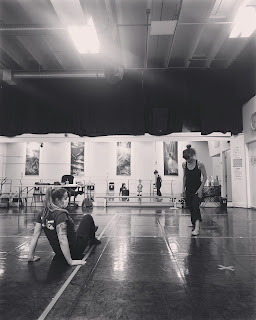
Rehearsal with Good Women in July 2021
I have never been a fan of learning the hard way. I welcome the past wisdom and advice of those who have walked the path before me. However, these past 2 years felt different as we were all figuring out how to continue with Arts creation with fluctuating pandemic restrictions and risk levels. My collaborative project with FEMME Vocal Quartet and Good Women Dance Collective was no different as we cancelled our live show, "The Beginning of Happiness," weeks before the premiere. It was a project we had all been rehearing since July 2019 and planning even before that time. Amongst the artistic core in the Spring 2021, we decided that a film would be a realistic and safe way of seeing through the project. Director of Photography, Tamarra Lessard, assembled a crew for us to film in August 2021. There were many logistics to consider in adapting the live music + dance show to a film. Park permits needed to be obtained for evening filming, costumes had to be adapted to be used in water, and most significant, the score was shortened from one hour to 30 minutes. The film is now available for streaming from February 17-24, 2022. Half of the proceeds will be donated to WIN House.

The Beginning Happiness Performers and Crew for August 2021 filming

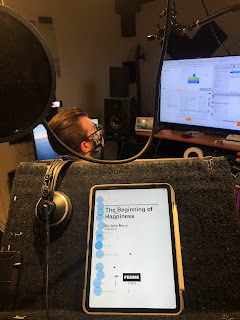
Recording at Silver Studios in May 2021 
During our recording sessions in May-July 2021, FEMME recorded the entire one hour work at Silver Studios. All the singers recorded their parts separately to stay covid safe and the recording engineers, Caleb Nelson and Amelia Chan, later layered the tracks to form the ensemble sound. This was possible since we sang to click tracks programmed to specific tempos and heard the playback of the other voices who had recorded their parts already.

My ears are greeted with the reunited sound of FEMME once again as listen to the album writing this post. The music is such sensitive and informed writing for treble voices. For a work that explores and reflects upon issues of domestic violence, there is a healing beauty within the musical storytelling. There is such a wide range of vocal textures created ranging from the warm feel of love to breathless unrest. After having this work living in my tablet for three years, I am so grateful that this music gets to live in the world. There is a wonderful sense of closure to be able to release this music and invite listeners in.


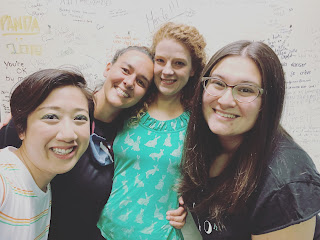
FEMME Vocal Quartet during Aug 2021 filming


The album is available for streaming and download from Bandcamp. We suggest a price of $10 for download but will gratefully accept donations above that amount. Proceeds from the album will go towards FEMME's continued work to amplify a contemporary female perspective within choral music through new commissions and performance.


Sunday, June 27, 2021

An Interview with Deirdre Kellerman


There is no such thing as perfect. This theme emerges as I chat with Tone Cluster’s new Artistic Director, Deirdre Kellerman. In fact, Kellerman feels that parting with the mindset of perfectionism holds the key to discovering who people are as singers.


This past year was Kellerman’s first working with Tone Cluster, a 2SLGBTQ+ choir based in Ottawa. Choir members met online for a weekly rehearsal and produced home audio and video recording content for their virtual performances. There are many singers that Kellerman has not even met in person. She acknowledges the amount of vulnerability for everyone participating in an online format. Kellerman shares her thoughts in this regard: “It was very hard to facilitate a safe space. The way I ended up doing it was going all in and programming intense and vulnerable concert themes: self-love, acceptance, and resiliency. I decided to lean in and that helped so much. It took the awkwardness out of Zoom when we were allowing ourselves to have conversations about resiliency and what that means in our life. Discussing this content in the streaming concerts. I think that was one of the things that got us through the year.”


Though an online season had its challenges, Kellerman focused on taking this time to facilitate discussion. Allowing this space for discussion set the choir down a path of working through A New Harmony, a workbook developed by GALA Choruses, the primarily North American umbrella for LGBTQ choirs. They have started to have conversations about equity, access, and belonging in choruses. The workbook has different workshop resources to discuss aspects of mobility, race, gender identity, sexual orientation, socio-economic status, mental health, and neurodiversity. Tone Cluster is looking forward to continuing to use a New Harmony as a guide in the upcoming seasons.


Oftentimes, during a regular performance season, there is a relentless pressure to learn music quickly for an upcoming performance. Whether conscious or subconscious, there is also a desire to have enough concert repertoire to justify the price of admission. “That is something I’ve always struggled with for several artistic reasons. Always feeling like there is a rush for singers to learn their music and a rush to get things done in rehearsal. Of course, that has to do with rehearsal methodology and efficacy, but it has been such a breath of fresh air to talk about why we’re singing particular pieces. It’s validating for me when I program something and hear the other singers’ connections to the music. It gives me a better sense of what clicks with them and doesn't and who they are as individuals, shares Kellerman.


There have also been profound changes for choristers singing and recording at home for a year. This perseverance to continue singing during a pandemic is a huge challenge. In many ways, it would be easier not to sing at all. However, Tone Cluster’s weekly virtual check-ins helped to maintain a sense of community. In this online format, Kellerman was intentional in giving her singers space to create: “I occasionally gave them instructions on where they should be or how they should dress. I always give them the opportunity, for at least one song, to go and record wherever in their homes or in their surrounding community that feels most authentic to them for the piece. To be as creative as they want to be. That has been game changing.”


Kellerman's view of a choir is not a mass of bodies singing together, but as a group made up of individuals, each with their own voice to share. With a social and political landscape that is becoming more charged with the inequalities facing people, both in the choral community and beyond, Kellerman reflects on her own approach to music making in this time: “Language matters… my journey with these ideas of decolonization and broadening what it means to be a choral artist has been about deconstructing the words success and excellence. Realizing it doesn’t always have to be music first. It can be connection, community, and stories first and that will allow us to create excellent music.”


There is a shift in approaches to collaborative choral leadership; however, rigid models of hierarchical teaching are still dominant in the classical music scene. This is a traditional model where a conductor determines the direction of music making. They likely have strong opinions of how to define musical excellence. Kellerman gives permission to their singers to not be focused on perfection, but instead, commit to communication of the music. It allows singers to experience the release from unhealthy expectations of perfectionism. Though these expectations can exist internally and externally, Kellerman has eliminated external ones in her role as a conductor. She goes further to clarify, “It doesn't mean that I don’t care about the quality of the music, because I do. I just think the way we get there can be in a more collaborative and engaging way with each other and the music. “


There is a huge role of unlearning that begins for any Artist when they begin to challenge whose definition of excellence they are trying to meet. Is it a Mentor? Organization? Conductor? Voice Teacher? Or perhaps one of the most critical yet, themselves? A toxic equation that outlines a direct relationship between performance expectations and self-worth.


Kellerman reminisces about the countless stories of shame singers have experienced throughout their training. Stories from a childhood where a singer was told that they need to mouth the words because their voice wasn’t good enough. They carry that vocal hesitation into adulthood and breakdown with gratitude as they enter a nurturing choral space as an adult. “Everyone has the right to sing,” states Kellerman with an assertive calmness. We need to “start from this place of ‘what stories do we want to tell? how do we feel about the music we’re singing?’ and stop talking about what styles or composers are for what singers,” states Kellerman.


Tone Cluster has a mix of demographics, such as young adults and recently retired, some newly out of the closet, some having lived decades within the queer commuity, and a significant number of allies that don’t identify as queer in the group as well. Kellerman elaborates, “they want to do better for each other. They want to learn how to be more accepting and welcoming. They are always striving for that. They are doing it in a way that is fun. They are serious about their inclusivity and enjoying their community together.”


Kellerman shares her approach to programming for Tone Cluster this past year and the current show: “I was drawn to what are our lived experiences that are the same no matter how we identify within the choir. I am really interested in diving deeper into an individual basis. Whether that is stories of people who were living during the AIDS crisis, which is not that long ago, or talking about what it’s like to not know yourself or have labels for yourself or knowing where you land. Those are all really important for queer organizations to focus in on. Tone Cluster has a great history of singing and speaking about social justice focused topics. We can go farther with queer centered stories written by queer composers. We have such talent within the organization itself. There are poets and storytellers. I would really want the choir to be in front of an audience and feel like they are telling their story.”


The idea of a decentralized form of leadership continues to surface during Kellerman’s verbal reflections, especially regarding the aspect of collaborative programming. While she acknowledges that there is so much ego that can be wrapped up in the role of conductor, she is interested to discover what a model of efficient collaboration can look like. Tone Cluster, in many ways, is an excellent group to explore this process of finding a new path of looking at leadership and direction. Kellerman hopes for the “singers in the choir, no matter their skill level or experience, to feel connected to the ensemble in an artistic way and that their voices are being valued.”


In a pandemic year of creation, Kellerman remains curious about what is to come: “I am fascinated about what people would have learned about themselves in this year of isolated singing. I imagine there are going to be struggles, whether it is tuning, balance, or even the emotions of being back with people again and singing. I want to prepare for anything. I am also anticipating real strength and development of skills. People have been forced to sing and learn music on their own; what that’s going to mean for choral singing. I don’t anticipate that people will shy into the background and rely on other peoples voices. They have been forced to find their sound and to accept their sound.”


Given the discussions that have occurred within Tone Cluster this past year, Kellerman is first to note that siloing can be a dangerous thing: “As much as it is beneficial to be talking about [equity] in a choral setting, I think this is a great opportunity as we are having these discussions to open the door a bit and note that all art forms are having these conversations. To be collaborating not just as an interesting way to get an audience through the door, but to diversify and deepen these stories and how they connect in our music community and audiences. I’ve always felt there’s been so many lines drawn between the choir world, the orchestra world or singer songwriter world and this is the time to be expansive,” reflects Kellerman, and “to collaborate not just for the sake of collaboration, but to connect, and create together.”


Deirdre Kellerman is a choral conductor and vocal coach based in Ottawa, ON, where she is the newly appointed Artistic Director of Tone Cluster - quite a queer choir, as well as the Artistic Director of Hypatia's Voice Women's Choir. From 2015-2
021, she was the Music Director at First Unitarian Congregation of Ottawa, and also worked as the Assistant Director of the Ottawa Choral Society. 
 

Deirdre has studied with Canada’s leading choral pedagogues, including a residency at the Banff Centre’s Choral Art program, studying with Michael Zaugg and Lone Larsen. She was nominated for the 2018 Leslie Bell Prize for Choral Conducting. An avid chorister, Deirdre has sung with a wide variety of ensembles, including Xara Choral Theatre, and the National Youth Choir of Canada. 

Deirdre holds a M.Mus in Conducting from the New England Conservatory and B.Mus in Vocal Performance from Acadia University.


Sunday, November 24, 2019

Voices In the Living Room


I will never tire of hearing the ranges of a human voice. There was a sense of warmth and play during New Music Edmonton's UltraViolet concert last night. They also invited guest vocalist and composer, Jane Berry, into their living room space. Chenoa Anderson, Allison Balcetis, Amy Nicholson, and Roger Admiral began with John Cage's Living Room Music as they each played items one would find around their home, such as a rifled through magazine or a 2x4 piece of wood. A rhythmic series of percussive taps and restless rustles of paper invited the audience into their on-stage domestic space. They also recited Gertrude Stein's "The World is Round," which introduced the voices of the instrumentalists into the space as well. They sat in a semi-circular formation complete with carpet on the floor, two recliners and two wooden chairs that looked like they had been been borrowed from a dining room set, a lamp on a side table, and even a plant perched at chairside.

Tanzer Lieder by Ana Sokolovic is structured with three different language voices in the five movements from French, German, and English. Sokolovic's writing demanded an array of vocal technique from Berry from the wailing vocal glides in Stimmen to the haunting vocal suspensions in Last Song. There was a cohesive tension created from the instrumentalists and Berry's vocals throughout the movements. The sounds from the piano and cello strings often matched the held frequency from Berry's own vocal folds. The pulsating vibrato on the flute gave an audible sound to the fluctuating breath heard in a body.

Alyssa Aska's The Woman and the Lyre: Sapphic Cycle shared many movements of vocal and instrumental play. I am more tremulous had a racing agitation between Anderson and Berry and there was good use of created reverb in Of the tacet earth where Berry's live vocal input was processed live and fed back to the audience on speakers surrounding the audience. It changed the resonating space around Berry's voice.

Chains  by Frederic Rzewski was by far one of the most playful as Berry read a local newspaper on the recent climate strike led by Greta Thunberg at the Alberta Legislature. Berry's speaking voice ranged from matter-of-fact to sarcastic depending on the sentence being read. A large repertoire of sounds were shared from tablet and phone ringtones, boxing gloves being used to play the piano, and the sound of the typewriter echoing the other voices on stage.

There was the world premiere of Berry's composition The Break, which shared text from a young woman, Cassandra Siwiec-Hlewka, with bipolar disorder. The poetry was from Siwec-Hlewka's first manic episode. Berry created opportunities for each instrument to have their own vocal line before introducing her own, which was the last in the progression. There was a sad beauty in the lyrical lines, but space between each instrumental introduction, as if space was being held for them on stage to be heard. There was this feeling of cyclical descent with text "catch me, under the water it's pulling me" and repeated phrases such as "I pray and I pray..." Out of the ebb and flow of vocal lines emerged a hopeful image of a flower blooming in the darkness. It was a beautiful image to finish the first half of the concert. An acknowledgement of the internal resilience that people possess even when their challenges are not visible.

Saturday, January 19, 2019

Ten Years to this Day


I am a singer.

There have been many moments in my life where I have wavered on accepting this title. But after 10 years of blogging, and over 20 years of choral singing, I know that who I am at my core is a singer. It is a huge component of my identity. Singing is an expressive means for me to communicate. While it is my pleasure to work with patients on discovering their communicative voice as a Speech-Language Pathologist, singing has always been and will continue to be my expressive mode of communication.

There is a overwhelming gratitude I feel towards the blog for holding me accountable to my passion: choral music. For the past 10 years, I have shared my thoughts while going through an artistic process and relayed these discoveries with my readers. In recent years, the blog has also developed into a platform where I am able to share the work of other singers, composers, conductors, organizations, and choirs as well. It is staggering to articulate the significance this blog has served for me, as well as others, over this past decade. I have enjoyed looking through my posts and photos to assemble some of my favorite moments. It's also exciting to look towards the future and contemplate what new projects, pieces of repertoire, singers, conductors, and composers I haven't yet had the pleasure of meeting.

Please enjoy this anniversary post and my apologies in advance since I'm certain people have been missed from this sampling of content. Regardless, thank-you, dear readers, for continuing to read my choral musings.

10 Year anniversary by Sable C

Listed below are 20 significant posts on The Choir Girl Blog over the past 10 year. Many of them signal a change in my role as an artist, thinking, or direction at each chronological time point in the blog.


1. Camp: A Rite of Passage

2. We'll Sing Anywhere

3. Choir Uniforms Do's and Don'ts

4. Arrival of the Virtual Choir 2.0

5. ESO Reviews

6. Making the Cut

7. Sh*t Choristers Say-An Interview with the Vancouver Cantata Singers

8. Tweet Me. Embracing Social Media at Podium 2012

9. Opera Girl

10. Painting the Nightingale

11. The Culture of Fear in Rehearsals 

12. Epilogue: Life after the Circus  

13. Dear, Opera Chorus

14. Backstage at Madama Butterfly 

15. I'm a bit of a hippie: An Interview with Cy Giacomin 

16. Interview with the Queen of the Night and Sarastro, Teiya Kasahara and Neil Craighead 

17. Podium 2016 Social Media Team  

18. National Youth Choir Class of 2016  

19. An Interview with Jane Berry 

20. The Formation of FEMME

Friday, January 27, 2017

An Interview with Jane Berry


To state that Jane Berry had a challenging year from October 6, 2015 to October 7, 2016 is an understatement. In addition to being a PhD student, professional chorister, running a beach volleyball club, and mother to 5 year-old Piper, she spent the majority of her time taking care of her mother, Marilyn Berry. Marilyn underwent surgery for brain tumour removal on October 6, 2015. Following that surgery, Jane witnessed her mom cycle through gains and losses while maintaining a connection to her mother through good humour and music.

Personally, as a fellow chorister witnessing Jane manage her multiple roles from the sidelines, it was staggering to see her navigate this complex process when reading her Facebook updates or chatting with her at choir break. I also remember catching glimpses of her composing her first major choral work, the Mass for Recovery: Phoenix Rising in dedication to Marilyn Berry, who passed away on October 7, 2016.

Initially, Jane’s Mass for Recovery began as a counterpoint exercise. She was a teaching assistant for a second year counterpoint class and found herself frequently sketching melodies in down time during lectures.

“I found myself writing the Kyrie, the section with the women's voices before the bass solo, the part that returns again at the end. Pro Coro was also starting to prepare for the Missae production last year. The year before we had done the Rheinberger, Praulins, and Frank Martin Mass. The opening Kyrie is basically adapted from Frank Martin’s mass; it had a huge impact on me. I recalled the line in my mind but not the true form of it, my mind had adapted that line. That is a strong musical quotation in my mind. I started writing just the Kyrie. I was working on it in Pro Coro rehearsal one day, and Michael [Zaugg] was looking over my shoulder, and said, “Oh, what’s that? a Kyrie? Send it to me.” I had very little done at the time; I had only that initial section completed. Six weeks later, I sent him the entire mass.“

She did not expect Michael to program the entire Mass. “In all honesty, Michael expressing interest in wanting to see it, and suggesting that we might perform it, was this really strange vote of confidence in me that I didn’t expect. I don’t know if I would have gone farther than the Kyrie,” she reveals.

“What happened when I started fleshing out the Kyrie, I started to incorporate my experience watching my mom. There is a voiceless motive in the Kyrie that was specifically related to my mom's recovery. Michael’s encouragement made me finish the Kyrie. That is when I had the motivation and inspiration to write the whole Mass and really link it to her recovery. Everything sprang from the motivation of wanting to finish the Kyrie. My mom was already in the hospital by the time I finished the Kyrie, and when she woke up from surgery, that was when I started being at the hospital every single day. Basically, six weeks after my mom finished having surgery, I was done the Mass. From there, I did the majority of edits after she died.” A warm tone of gratitude is evident when Jane speaks about Michael’s role. She lauds his patience and his collaborative input in the editorial process of the score.

Jane chose to use the Mass framework and Latin text in a modern way: “I think having a contemporary setting of that text was important. If I had been too traditional with it, it wouldn’t have felt like a representation of my mom. She was both religious and contemporary as well. I tried to reflect that balance she had in the setting of it.” Each of the Mass movements is also paired with a subtitle that documents a stage in her mother’s recovery: Kyrie - The Speechless Awakening, Gloria - Breakthroughs & Breakdowns, Credo - Turbulence, Memories & 1000 Needles, Sanctus - The Battle of Glenrose*, Benedictus - Angels & Prayers, Agnus Dei - Going Home. “The entire piece was based on her rediscovery of things that she lost during surgery: language, memory, lucidity to some extent. This battle of regaining and losing, having these amazing breakthroughs and ridiculous regressions where she would go from fluent speech one day to nothing the next,” Jane states.

“One of the things I have an incredible amount of respect for my mom was that she was so liberal and progressive. Working as a feminist, working for women’s rights, running a shelter for battered women and children, and being a social worker. It was really interesting to see her involvement with religion. It’s something that hugely influenced my life. I remember times when we went to this church that was huge, and borderline cultish,” she says with a laugh, “but they had a really good music program. She would lean forward during the sermon, loud enough so many around us could hear, “ok, and this is where the pastor interpreted things a little wrong, this historically happens very often, the wife doesn’t actually have to serve…” Whenever it came to issues of gender in the church she was very vocal about her rationale about how she compromised with this liberal side of her and how she consolidated with her interpretation of religion,” she says.

There is a meticulous musical design behind the entire work: “Basically, my theorist self made me write it chronologically. My idea behind the whole thing is the structure of two tonalities. If you look at any of the movements, there is a underlying structure of a ninth: first movement has C minor and G minor overlapping so the fifth becomes the root for the next chord etc. etc. It starts in C, with the ninth reaching up to D, and the D then cycles through acting as the root of the next movement. It worked out with the six movements I could end up back in C so it forms a full circle. That idea came really early to me. There was a duality in her recovery process, progression and regression, so having two kind of competing tonalities seemed appropriate. Somehow I also feel like this duality relates to her her decision to finally have surgery. Although she was diagnosed in 2003 she decided not to have surgery at that time. We were all supportive, especially in retrospect, knowing that she may not have lived to see my daughter if she had chosen to have surgery at an earlier stage. But she had such a good quality of life in the interim. There was this dichotomy in every aspect of her recovery. She was stuck between two worlds. She was aware of what she had lost. The more lucid she was the more painful it was for her. Near the end, she was almost calmer.”


Each of the movements documents its own story in the recovery process: “The Benedictus, Angels and prayers, was about a few specific nurses from the U of A Hospital. They would take her for extra bubble baths, shut the door, and sing to her. It was my mother’s favourite thing. The movement began as detailing these specific individuals and then changed to represent a sort of resignation. This movement was the most religious movement for my mom. She was struggling with faith and understanding why things were turning out the way they were. Now the Benedictus has evolved to be more about the period in time when she got to come home. Where my daughter, Piper, could come in and dance around her and give her hugs.” Jane wove the fragments of melodies she would sing at her mother’s bedside within the Credo: Bizet’s Habanera, Garth Brook’s The River, and the American folk tune, Cross the Wide Missouri. Her mother knew the Kyrie and Gloria the most. There is a Laudamus Te melody in the Gloria, which her mother knew as “her song.”

The subtitles of the movements became more prophetic than even Jane could have predicted. She titled the “Battle of Glenrose” before her mother was even admitted as an inpatient. Prior to that transfer, Marilyn spent just over three months at the University of Alberta Hospital recovering from her neurosurgery. It was her mother’s move into the Glenrose that signaled the start of many complications, especially her struggle with depression. The Agnus Dei “Going Home” relayed the feeling of the unknown, as it was originally written while Marilyn was still in the hospital Jane was unsure of what the end would really look like, whether going home would represent a return to their apartment or her mothers passing.

It is no surprise that Jane wrote the piece with Pro Coro’s sound in her mind. She is blunt in stating that the work wouldn’t be as good as it is if she had to limit herself in term of functional composition restraints such as range. She wrote parts with specific chorister voices in her mind. Her experience as a singer is also apparent in the score since soloistic lines weave throughout all voice parts. She wrote melodies she would want to sing.

Jane notes that Pro Coro’s upcoming concert with the premiere of Mass for Recovery: Phoenix Rising will feel like a memorial in some ways. Many of the individuals she would have wanted to be at her mother’s memorial in Edmonton will either be singing in the concert or are planning to attend. Her sister is flying in from Halifax the day before and her family here in Edmonton is waiting for the end of winter before travelling back to Halifax for a ceremony in their home province.

Speaking as a chorister and friend who has witnessed Jane’s life from the sidelines, it is a true pleasure to be able to premiere her work. I feel honoured to be part of the choral community that can help a fellow chorister remember her mother, channeling our collective voices through a musical medium. In April 2016, I was part of a quartet of singers that sang at her mother’s bedside. I still recall the look in her mother’s eyes. There was spark of excitement but tears pooling at the edges. I remember how lucid she looked, and how Jane laughed when she realized the strength of her mother’s grip on her arm as she was trying to pull away. The Mass for Recovery reminds me that when a loss for words renders us speechless, we will always have the role of music to communicate what cannot be spoken.


Pro Coro Canada will premiere Mass for Recovery: Phoenix Rising Sunday January 29, 2017 at their Missae IV Concert. All Saints Cathedral at 2:30 PM.
 
*The Glenrose Rehabilitation Hospital is a facility providing inpatient and outpatient services in Edmonton, AB.
 
Jane grew up singing and composing from an early age before eventually going on to begin her music studies at Acadia University where she completed a BMUS in Composition. She then continued to complete a MA at the University of Ottawa and is now in the final year of her PhD at the University of Alberta. Jane Berry is thrilled to be performing as a member of Pro Coro Canada for her fifth season now and is also a member of several of Pro Coro’s specialized smaller ensembles. Jane enjoys working as a vocal coach for the Etown Minors acapella group, teaching at the University, running a local beach volleyball training facility, and most importantly, spending time with her beautiful daughter, Piper. Her academic research interests include music cognition, autism and sensory sensitivity issues, abstract and graphic score analysis, and popular music studies. After a long hiatus from composition Jane recently found herself compelled to pick up writing again following some difficult life events and has since found a renewed joy in composition.

Tuesday, April 12, 2016

An Interview with Composer, Dr. Benjamin Bolden


Dr. Benjamin Bolden's is winner of the Choral Canada 2016 Competition for Choral Writing for work, Tread Softly. This work will be premiered by the National Youth Choir of Canada at Podium Conference and Festival.

You have mentioned that the inspiration for Tread Softly begin following a TED talk on Education with a theme of treading softly when it comes to educating children, how did you highlight this theme in the music?

When the text ‘tread softly’ is first heard, the sopranos sing a simple, gentle, do-mi-do motif. The altos echo the motif in canon. Meanwhile, the tenors and basses start low in pitch and move steadily upwards, in parallel harmony, like a child growing up. Then the sopranos break out in a yearning, descending motif on the text ‘you tread upon my dreams.’ The lower voices echo the word ‘my dream’ low in their range, in a harmonic language that shifts to a new ominous-sounding tonality. For me, that harmonic shift signals the danger of quashing dreams.

 
What resonated in the text for you in W.B. Yeat's Poem, The Cloths of Heaven?

Had I the heavens’ embroidered cloths,
Enwrought with golden and silver light,
The blue and the dim and the dark cloths
Of night and light and the half light,
I would spread the cloths under your feet:
But I, being poor, have only my dreams;
I have spread my dreams under your feet;
Tread softly because you tread on my dreams.
What resonated for me was the generosity and vulnerability of someone laying themselves out before someone else…the trust implied, and the need to respond thoughtfully, conscientiously, and with care.

What do you hope for the National Youth Choristers to take away from Tread Softly when they premiere it at Podium 2016?

Well… I hope the individual parts are interesting enough that the singers are engaged by what I’ve asked them to sing. And I hope they are able to wallow a little in some of the lush harmonies I’ve written. I also hope they can let loose and feel a thrill in the climactic moments. I sing in choirs too, and in the pieces I love best I find moments that I look forward to and relish—when my voice has the chance to sound the way I want it to sound, or when I get to contribute to a musical gesture that just works. I hope the singers find some of those sweet spots in this piece! Ultimately, I hope the singers feel they’ve been able to tap into their own musicality, give it voice, and help to create something beautiful.

Where was the initial inspiration for you to become a music educator?

I was inspired to become a music educator because I have seen so many lives so tremendously enriched by music—especially my own. I figured that bringing music to people, and people to music, was a pretty fantastic way to earn a living. It’s an immense privilege…and responsibility!

How do you view your roles and responsibilities as a music educator?

Basically I try to enhance and expand and strengthen the relationship between people and music. I once heard the brilliant Canadian composer and educator Stephen Hatfield say, ‘there are as many ways to be musical as there are ways to be beautiful.’ That rings very true for me. As a music educator, I try to help people realize how they can be beautiful in and through music.

You have a diverse background in composition, education, and academic research, why is it important for you to assume these different roles?

Because it’s so much fun! I love operating within these different roles. They all complement each other and they are all so compelling. And if I get weary of one of the roles I can move to the other to recharge and re-energize…I’m pretty lucky that way.

You have created a series of Podcasts that share your relationship with music. Why did you choose this medium to narrate your story?

Podcasts are wonderful for communicating about music, because you can combine music and spoken word together. And playing with those sounds is, for me, very much a form of composing.

You have had exposure to many genres of music by members of your family, early music from you mother, The Police from your brother, but what do you think is at the heart of choral music that connects with you?

At the heart of choral music, for me, is the notion of raising voices together. Connecting to an ancient and time-honoured musical practice that happens across eras and cultures. I think it’s such a wonderful thing to get together and do!

The National Youth Choir Spotlight Concert will be at the Winspear Centre on Friday, May 20, 2016 at 8 PM. Tickets are available online.

Hear Bolden's Easter Antiphon Online.

Dr. Benjamin Bolden, music educator and composer, is an associate professor in the Faculty of Education at Queen’s University. His research interests include the learning and teaching of composing, creativity, community music, arts-based research, Web 2.0 technologies in education, teacher knowledge, and teachers’ professional learning. As a teacher, Ben has worked with pre-school, elementary, secondary, and university students in Canada, England, and Taiwan. Ben is an associate composer of the Canadian Music Centre and his compositions have been performed by a variety of professional and amateur performing ensembles. Ben was editor of the Canadian Music Educator, journal of the Canadian Music Educators’ Association/L’Association canadienne des musiciens éducateurs, from 2007-2014. He is the proud father of three rascally boys.

Friday, November 13, 2015

An Interview with Composer, Kristopher Fulton.


As composer, Kristopher Fulton, discusses the release of the new The Twilight Cities CD by the Vancouver Cantata Singers, certain themes arise: perseverance, timing, support, and passion. In Fulton’s second season as composer-in-residence with the Vancouver Cantata Singers there were discussions surrounding the choir’s content creation in the form of a recording. “A continuous stream of content is a requirement of active ensembles. Lots of people want to put content out there, whether choral or instrumentalist, the whole spectrum of performers. Now it’s not just concentrated in a one shot, exclusive concert. The other audience members who couldn’t come out have an opportunity now,” Fulton states as he discusses the benefit of recording.

Fulton has had a generative and collaborative relationship with the Cantata Singers for ten years before becoming the composer in residence. He sings in the choir and the group has commissioned works such as Prometheus and Medusa for the CBC Choral competition in the past before becoming the current composer in residence. It was a dream of Fulton’s to have an a capella album of his own work. “An album of choral work that is 40-60 minutes is an undertaking for everybody be it rehearsal time or money or cost. I was in a position to make it happen if I was able to raise the funds myself. I got the funding together privately and the timing was right to do it at this time” states Fulton with fervor. With the support of Cantata Singers’ Artistic Director, Paula Kremer, and the Cantata choristers, they recorded over two evenings at the Chan’s Centre for Performing Arts. They had sound engineer, Matt Stephanson, overseeing the recording process since Fulton was busy singing with the tenors during the recording.

Fulton states, “there’s a certain amount of perspective that you get from singing on the album. There’s a trade-off. You give up the objective overview in the booth. Luckily, Paula, myself, and the sound engineer have a similar perspective on what a choral recording should and shouldn’t sound like. We have a working relationship where our taste is similar. That was enormously helpful.” In fact, Fulton states that he feels more anxious when he is just sitting in an audience having heard no prior rehearsals when choirs are performing his works. “Often it’s sometime jarring when you hear your piece and it’s not what you had been hearing in your head. Having that rehearsal process for me, as a performer, not just as a composer, you have to let something go if you are going to appreciate other things as a composer,” he cites as an advantage of providing his physical voice in his works.

It is clear that Fulton was humbled to have the voices of his Cantata friends and colleagues record his works. “The choir was incredibly dedicated and they had a small window of time, only three to four extra rehearsals to fine tune the pieces. They did a wonderful job with it and I am so happy with the result,” he gushes in his mild manner. However, there is always another layer of stress that comes with a recording session. “Everyone goes into a different mode, it’s different than the mode you switch into during live performance. You raise the standard. In a live performance, you realize it’s not going to be perfect. The expectations for a recording are different. There are lots of people who would expect a recording to be perfect or near perfect,” he says when reflecting upon the challenges of recording. Two moments in particular stand out to Fulton: “In Icarus there’s a line, ‘Climbs up to the highest cliffs of his island prison court.’ The choir really sang out with a lot of emotion,” he says before sharing his second moment in Songs of Ariel where the tenors have to have weave their solo line all the way up to a high A. “It’s enormously challenging to make a good sound to nail that and the cut-off,” he said reveling in the satisfaction of that successful take.
Vancouver Cantata Singers
Scanning the titles of Fulton’s choral works such as, Icarus, Prometheus, and Medusa; a common theme is revealed: archetypes. “I’m a huge fan of combining old and new. Old in this case is Mythology and new would be the aesthetics of the music I am writing. I’m attracted to archetypal characters, modern mythologies, and what you see in comic books. We see these archetypes over and over again and there’s a reason that they are so appealing. They represent the very best of humans and, in some cases, the worst of us. There’s something emotional and operatic about those archetypes. That is something that always seems to weave its way into my work. There is a strong sense of emotion to me. I just want people to feel something," he says. Fulton also reveals that audience members often bring up how cinematic his music sounds. Fulton states that he never sets out to say: “this will be a cinematic piece and it’s going to sound exactly like a movie!” in his impersonation of a pompous tone, which is a comedic contrast to his humble nature. “I think it’s just who I am,” he says abandoning the character. “I love movies and dramatic emotional content. For people to hear that come out in the music and for people to come and tell me that is a huge compliment.”

Fulton maintains an open perspective when it comes to people’s interpretation of his work. He enjoys the fact that “it means something different to different people.” However, he does note how cool it is for people who have never met him to feel connected to him as a person through his work. “It’s an enormous leap when someone comes up and they feel that they know you because of your work not having met you in person beforehand. I’m an emotional being. I’m an artist who would want people to get to know me through my work. They get little pieces of who I am along the way. I never meet or speak to them but they get a part of me,” he states in an appreciative tone.

As for what is coming up next, Fulton gives a teaser that he has an interest in a composition for choir and orchestra. “It would be a contemporary setting, and it would have sacred undertones, but it would not be a sacred work,” he says in a mischievous tone. A multitude of unique projects are on Fulton’s mind. It is apparent during this musing that he still has many character stories to tell through his music.

The album is available for download in all digital stores such as iTunes and Bandcamp.